Can a podcast studio help with distribution, not just recording?
Does a podcast studio help with distribution? Yes—when publishing is in scope. Compare recording, editing, RSS setup, and who owns the final upload.



Yes, a podcast studio can help with distribution when its service includes publishing support, not just recording and editing. That support can cover host uploads, RSS feed setup, episode descriptions, video publishing, and release checks. A finished recording is not a published episode: confirm who handles each distribution task before you book.
TL;DR
Yes—but compare the work included, not the label on the package. A studio can deliver excellent recordings without uploading anything to your podcast host or video channel. Ask for a written list of deliverables and responsibilities.
For Denver entrepreneurs, Dialed Studios provides done-for-you podcast and video production, fully customized branded sets, a dedicated producer and engineer, editing, and content strategy. Its guaranteed 48-hour editing turnaround gives you a concrete editing deadline. Confirm hosting, account setup, uploads, and publishing separately rather than treating production support as proof that distribution is included.
Recording only
Recording and editing
Production with distribution support
These are service scopes to compare, not named studio packages. In 2026, the decisive question is still simple: does the handoff end with a file, or with a checked, live episode?
Your audience cannot listen to an episode sitting in a delivery folder. Someone must approve the edit, prepare the publishing information, upload the correct files, and verify the release.
For an entrepreneur or personal brand, unclear ownership creates another job after recording. Choose the workflow that removes work you cannot reliably handle—not merely the workflow that produces a polished recording.
Distribution also differs from promotion. Making an episode accessible does not guarantee listeners, audience growth, or business inquiries. Set expectations around completed tasks before discussing results.
Recording-only support fits when you have an editor, a publishing process, and someone responsible for release day. You delegate capture while keeping the rest of the workflow under your control.
The benefit is a clear division of labor. The limitation is equally clear: your team must turn the recorded material into something listeners can access.
Before choosing this scope, establish what files you receive and how the handoff works. Ask whether audio tracks and video files arrive separately, whether any processing is included, and who checks that the delivered files are complete.
Best for: creators with an existing post-production and publishing team. Do not choose recording-only support if your actual problem is getting episodes out after the session.
Recording and editing support removes the production work specified in your agreement. It does not automatically include episode descriptions, cover artwork, host uploads, or channel scheduling.
Ask what the final delivery contains. An approved audio master, a full-length video, and a short promotional clip serve different purposes; none establishes who presses publish.
The guaranteed 48-hour editing turnaround at Dialed Studios addresses editing speed. It is not a stated guarantee that an episode will appear on listening platforms within the same period. Keep the edit deadline and publication deadline separate in your 2026 release calendar.
Best for: business owners who want production handled but can assign publishing internally. The trade-off is that your publishing owner still needs time, access, and a release checklist.
Distribution support is useful when the agreement names the work between approved files and a live release. Specify the destination, the task, the owner, and the approval required.
For audio, that can mean uploading to a podcast host, preparing episode information, and checking the RSS feed. For video, it can mean preparing a separate upload and checking the channel presentation. Do not assume the audio workflow publishes the video version too.
The benefit is less coordination on your side. The limitation is that outside support still needs your decisions about sensitive edits, business claims, guest details, and release timing.
Best for: entrepreneurs who want publishing execution delegated, not just content creation. Retain account ownership and require a clear handover process if you change production partners.
The amount of help you need depends on your publishing setup and the responsibilities you retain. Use these factors to define scope rather than accepting a broad promise to handle everything.
None of these factors proves that a particular studio includes distribution. They tell you what to ask about. Write the agreed answers into the scope before your first session.
Use a documented sequence for every release. The following workflow separates creative work from publishing work so that an unfinished task cannot disappear inside a general production handoff.
The order matters. Preparing metadata before approval can create rework if an edit changes the episode's focus. Scheduling before the correct files arrive creates a different problem: your calendar looks finished while the release is not.
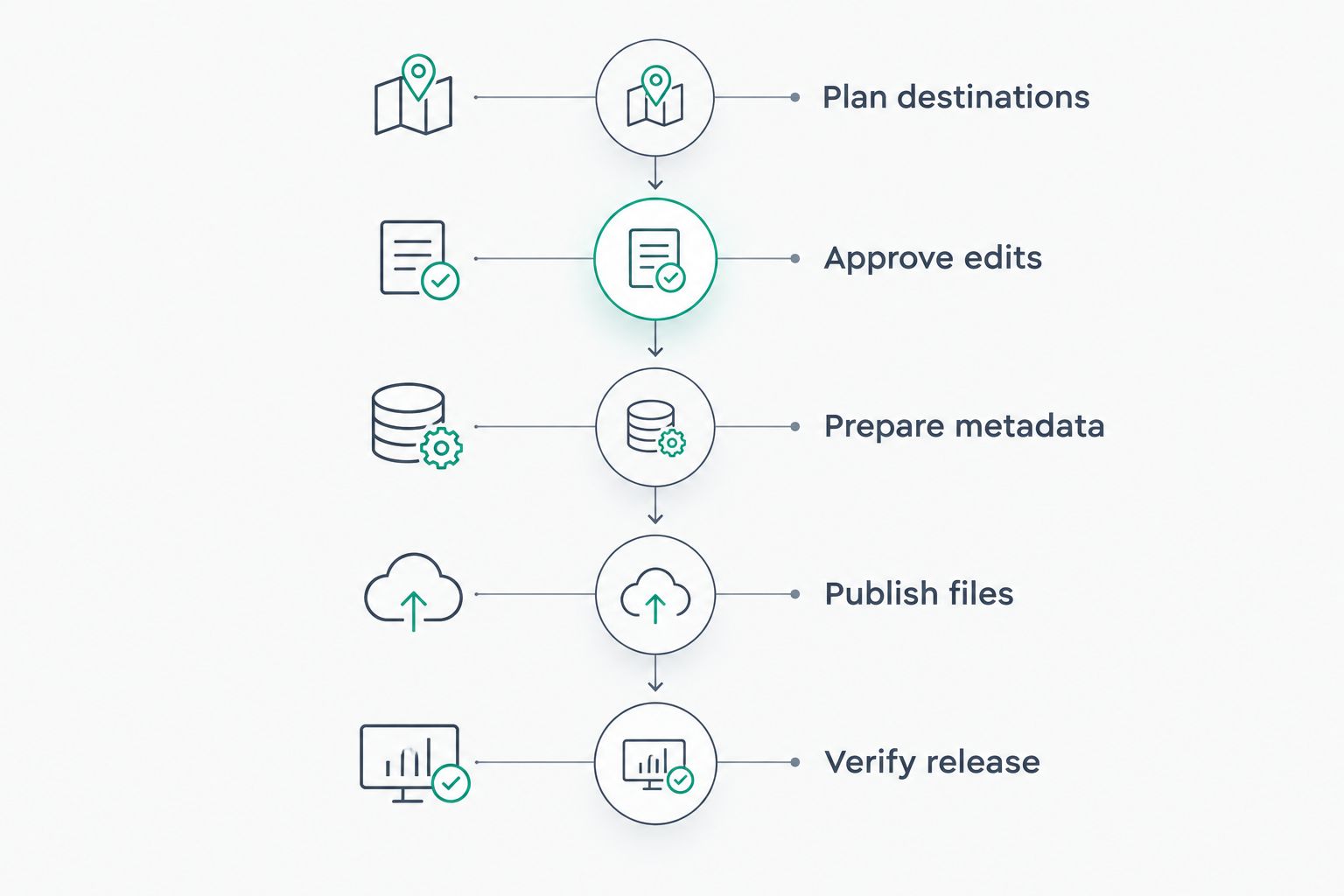
Assign publishing and release verification separately from recording and editing.
For the audio-specific handoff, the podcast recording to Spotify and Apple workflow addresses the path from studio output to listening destinations. Keep a named owner attached to each stage, even when the same production partner handles several stages.
A practical 2026 production brief should also record where approved files live and how your team signals approval. Avoid relying on scattered messages that leave the publisher guessing which version is final.
Replace broad language with observable completion criteria. A promise to support your launch is less precise than an agreement to upload an approved episode, schedule it, and check its public presentation.
Your written scope should answer these questions:
Keep business-owned accounts under business control. Grant the access needed for the work rather than making an outside provider the only person who can reach your show.
Define the approval checkpoint too. A production team should not have to guess whether a sensitive client reference, guest statement, or business announcement is ready for publication. Your agreement should explain who makes that decision.
For a new show, distinguish setup from recurring work. Creating a feed and submitting it to listening platforms is not the same task as publishing later episodes through that feed.
Publishing answers where your content appears. Content strategy answers why someone should watch, listen, or take another step. Decide what that next step is before writing the episode description.
For a business podcast, the destination might be an existing service page, newsletter signup, or relevant episode. Choose the destination that matches the conversation rather than sending every listener to an unrelated general page.
When several channels point to a shared landing page, tools for tracking audience clicks address a different measurement task from podcast listening analytics: whether people follow the links you publish. Keep those signals separate; a link click does not prove that someone completed an episode or became a customer.
Build the measurement plan into your 2026 publishing brief. Record which link belongs with each release and who checks that it works. That makes the next action part of the publishing process rather than an afterthought added to the description.
Avoid claiming that distribution alone creates demand. Accessible episodes, relevant topics, clear packaging, and a sensible next action each do different work. Evaluate them separately when deciding what to change.
Dialed Studios is best for Denver entrepreneurs and personal brands seeking done-for-you podcast and video production. Its stated offering combines fully customized branded sets, studio equipment, a dedicated producer and engineer, editing, and content strategy.
Those services address the work around making the content. Fully customized branded sets support the visual presentation; the dedicated producer and engineer provide production support. Neither detail, by itself, establishes responsibility for your host account or publishing schedule.
The guaranteed 48-hour editing turnaround gives your team a defined point for planning the next handoff. Ask how that editing commitment connects to approval, any requested changes, and your intended release date.
The limitation to resolve is distribution scope. Confirm who handles uploads, feed setup, metadata, scheduling, and live checks before treating the studio as your publishing operator. That distinction lets you choose a creative partner without assuming services beyond the stated offering.
Discuss your production workflow
Define recording, editing, content strategy, and publishing responsibilities before your session.
Finish your 2026 production brief with a release checklist, not just a session booking. Name the recording owner, editing owner, approval owner, publishing owner, and person responsible for checking the live result.
Then test the handoff on an actual episode. Follow the approved files through upload and public playback, and note any step that still depends on an informal reminder.
Choose the service scope that closes those gaps. If publishing remains your responsibility, reserve time for it. If you delegate publishing, define what successful completion looks like and retain access to the accounts.
Does a podcast studio help with distribution or only recording?
A podcast studio can help with distribution when publishing support is included in its service agreement. Confirm host uploads, RSS setup, metadata, scheduling, and release checks individually.
Will my studio upload episodes to Spotify and Apple Podcasts?
Only assume the studio handles those tasks when the agreement explicitly assigns them. Ask who manages the podcast host, initial platform submissions, and recurring episode publication.
Does editing include publishing my podcast?
Editing does not automatically include publishing your podcast. An approved episode file still needs metadata, an upload, release settings, and a final public check.
Can a podcast studio help publish a video version too?
A podcast studio can help publish video when video delivery and channel publishing are included in scope. Confirm the video files, upload responsibility, titles, descriptions, and approval process separately from audio.
Does Dialed Studios guarantee publication within 48 hours?
Dialed Studios states a guaranteed 48-hour editing turnaround, not a publication deadline. Confirm publishing responsibilities and release timing separately.
Who should own my podcast hosting account and RSS feed?
Your business should retain control of its podcast hosting account and RSS feed. Give production partners the access needed for agreed tasks and document the handover process.
Will distribution support guarantee more podcast listeners?
Distribution support does not guarantee more listeners. It handles the agreed publishing work; audience growth also requires decisions about topics, packaging, promotion, and measurement.
An episode can be uploaded correctly and still disappoint the listener if the wrong edit, broken link, or incorrect title reaches the public page. Make audience-facing verification the finish line—not the upload confirmation.
Before your next release, ask the publishing owner to open the public episode and check it as a listener would. That specific responsibility closes the gap between delivering content and actually distributing it.