Do I need a content strategy before starting a podcast?
Do I need a content strategy before starting a podcast? Yes. Define your audience, episode purpose, and publishing workflow without delaying your launch.



Yes—you need a clear content strategy before starting a podcast, but you do not need a finished editorial calendar to record your first episode. Decide who you serve, what your show helps them do, and how you will publish consistently; production quality cannot make those decisions for you.
TL;DR
You need enough strategy to give every episode a job—not enough paperwork to delay recording. For an entrepreneur or personal brand, that job should connect a listener’s problem with something you can explain clearly and credibly.
Before your first recording, complete these steps. Treat them as your minimum launch brief, not a permanent rulebook.
For a business-focused show, start with the questions your prospective clients already ask. The content strategy guide for business coaches is a relevant next read if your podcast supports a coaching business.
Your 2026 launch brief should guide a real recording session. If it cannot help you choose a topic, brief a guest, or approve an edit, simplify it.
A podcast creates several decisions before anyone presses record: the subject, the guest, the opening, the takeaway, and the follow-up. Without a shared direction, you have to make those decisions separately for every episode.
A content strategy gives those choices a common purpose. It also gives your production team instructions beyond making the audio sound clean.
For an entrepreneur, the distinction matters. An enjoyable conversation and a useful business episode are not automatically the same thing. You need to know what makes an episode worth publishing for your intended listener.
Plan the listener’s takeaway before planning the camera angle. You can improve delivery through practice; an unclear premise requires a different conversation.
Use a short working brief with the sections below. Write decisions, not aspirations: replace language about inspiring people with a specific description of what your show will help them understand.
Describe your listener by situation, not just a broad demographic. A founder preparing to hire has a different immediate problem from a founder preparing to sell a business.
Ask what the listener already knows, what they are struggling to decide, and what would make your explanation useful. That context determines how much background your episodes need.
Avoid making everyone your target audience. You can welcome a broad audience while designing an episode around a specific person’s question.
Write a sentence that connects your expertise with the listener’s recurring need. Keep it specific enough to reject an attractive but unrelated topic.
For example, a hypothetical business coach might build a show around helping founders delegate decisions. That premise gives the host a reason to discuss hiring, accountability, and management without turning the podcast into a general business conversation.
The promise is an editorial filter. Use it when deciding whether a guest, anecdote, or proposed episode belongs.
Assign each episode a takeaway. A listener might leave with a clearer decision, a question to ask their team, or a process to examine.
Then build the outline around that result. Put the central question near the opening, develop the explanation, and finish with a practical next step.
This is not a requirement to script every sentence. It is a way to keep a natural conversation pointed toward a useful answer.
Name the person responsible for each stage: preparation, recording, editing, review, and publication. Separate delivery of an edited file from approval to publish it.
Your 2026 publishing plan should reflect your actual review capacity. A finished edit still needs someone to check names, confirm the intended message, and authorize release.
Choose evidence that matches the purpose of the show. Listener questions can guide future topics; relevant inquiries can help you assess whether the show is attracting the people you want to reach.
Do not treat every metric as a business result. A play count describes consumption, while a qualified conversation tells you something different about commercial relevance.
Set your criteria before launch so you know what to review. Avoid inventing a performance target without a baseline or a reason for choosing it.
Choose a lean strategy, then use recording to test whether the premise works. Planning and practice solve different problems: planning sets the direction, while recording reveals what you can explain clearly.
Lean launch brief
Detailed editorial plan
Unplanned recording
You do not need to predict every future episode. You do need to explain why the next episode deserves your listener’s attention.
Do not confuse a detailed document with a settled decision, either. A long calendar built around an unclear audience remains an unclear strategy.
Turn the show-level decisions into instructions for the next session. Your recording brief should let the host, guest, and producer understand the same intended outcome.
Use this sequence:
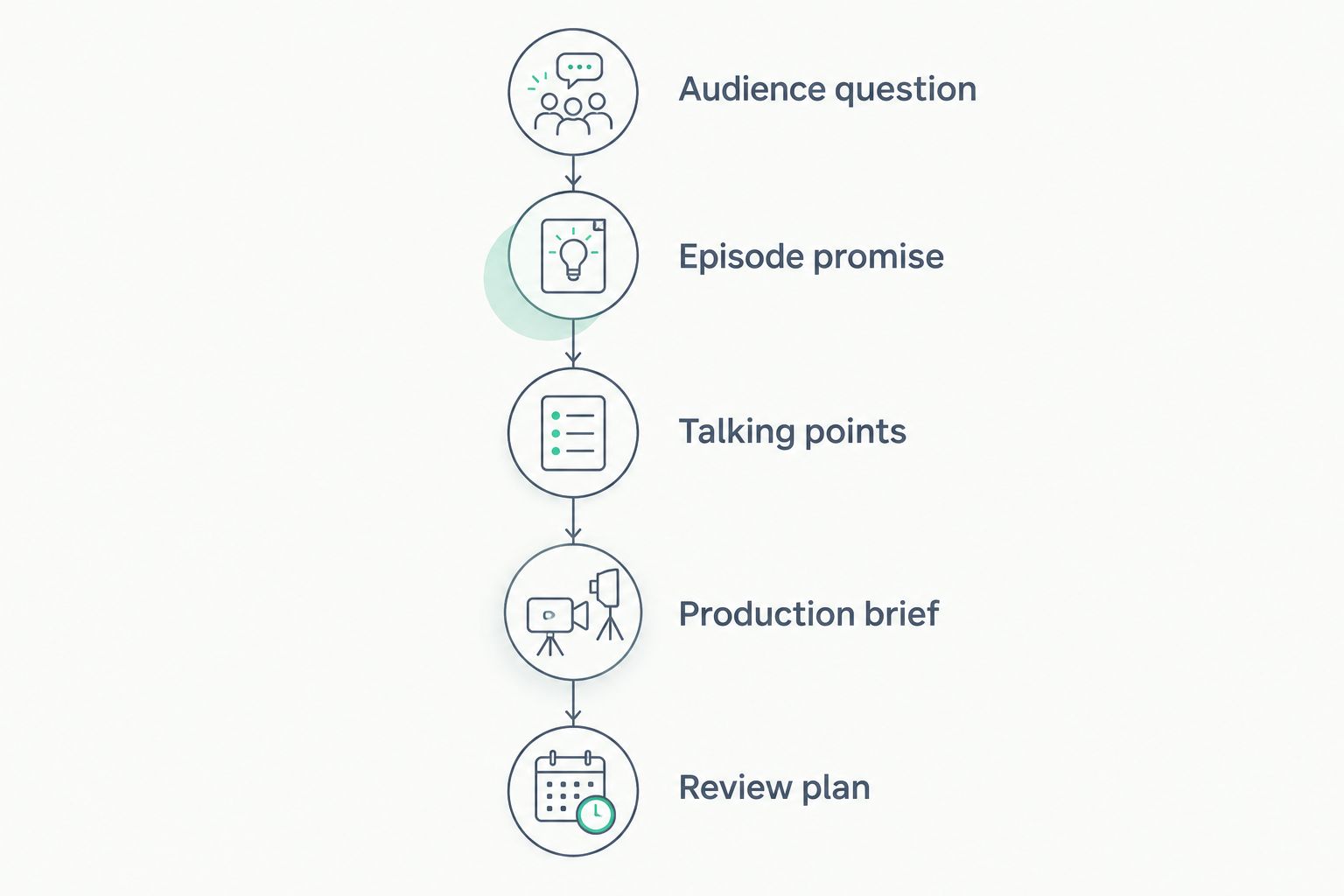
Set the episode’s purpose before specifying how it should be produced.
For your first 2026 recording, use the brief to rehearse the opening and conclusion. If the opening promises something the conclusion never delivers, revise the outline before the session.
Give guests the central question and the boundaries of the conversation. Ask for relevant examples rather than sending a script that requires rehearsed answers.
After recording, check whether the strongest material still answers the original question. Change the title or framing if the conversation produced a different useful answer; do not force the edit to support a promise the recording cannot fulfill.
The right level of planning depends on what your podcast must coordinate. Use these factors to decide where your brief needs more detail.
None of these factors requires a complicated document. They require a decision someone can act on.
You need the same audience promise for audio and video, but your production brief must account for both experiences. Explain visual references aloud if the episode also needs to work without a screen.
For video, decide what the setting should communicate before recording. Fully customized branded sets serve a different purpose from an episode outline: the set establishes the visual environment, while the outline directs the conversation.
If video is part of your 2026 launch, include the intended viewing context in your brief. Do not assume that recording cameras automatically gives you every finished format you want to publish.
Dialed Studios is best for Denver entrepreneurs and personal brands that want podcast content strategy and done-for-you production from the same team. Its services include fully customized branded sets, studio equipment, a dedicated producer and engineer, editing, and content strategy.
The guaranteed 48-hour editing turnaround gives you a concrete production commitment. It does not replace your editorial decisions, your expertise, or your responsibility to approve what represents your business.
At Dialed Studios, the relevant distinction is production partnership rather than room rental. You can plan the content alongside the team responsible for producing it.
The trade-off is coordination. You still need to explain your audience, provide accurate subject knowledge, and make approval decisions; done-for-you production is not a substitute for your point of view.
Plan your podcast production
Discuss content strategy, fully customized branded sets, and dedicated production support.
Your strategy is ready for a pilot when you can explain the listener, the episode’s purpose, and the publishing responsibilities without improvising those answers. You do not need certainty about the entire show.
Read the brief aloud to someone unfamiliar with the concept. Ask them who it serves and what they expect to learn; use their response to check whether your wording communicates the intended promise.
For a 2026 launch, finish with an operational check: who supplies the topic, who prepares the session, who reviews the edit, and who publishes? Unassigned work is not a publishing plan.
Do I need a content strategy before starting a podcast?
Yes, you need a clear audience, show promise, episode purpose, and publishing workflow before launching a business podcast. Start with a short working brief rather than waiting for a complete editorial calendar.
Can I record a podcast before my strategy is finished?
Yes, you can record a private practice episode while refining your strategy. Use the recording to assess your delivery and topic clarity before committing to publication.
Do I need to script every podcast episode?
No, you do not need to script every podcast episode. A focused outline can establish the opening question, key explanations, and closing takeaway while leaving room for natural conversation.
What should I include in a podcast content plan?
Include your intended listener, show promise, episode questions, production responsibilities, and publishing process. Add success criteria that reflect why your business is creating the show.
Should my business podcast cover only what I sell?
No, your business podcast should address problems relevant to the people you serve, not just describe your services. Keep the connection to your expertise clear without turning every conversation into a sales pitch.
Can Dialed Studios help me plan and produce a podcast?
Dialed Studios provides podcast content strategy and done-for-you production in Denver. Services include fully customized branded sets, equipment, a dedicated producer and engineer, and a guaranteed 48-hour editing turnaround.
Does a fast editing turnaround mean my episode is ready to publish?
No, editing delivery and publication approval are separate steps. Assign someone to check factual accuracy, names, and the intended message before releasing the episode.
Write the next episode’s closing takeaway before you write its opening. This gives you a practical test: does the planned conversation actually help the listener reach that takeaway?
If you cannot answer, narrow the question. Your first strategy does not need more pages—it needs a clear reason for someone to listen.