Is it cheaper to buy podcast equipment or rent a studio?
Buy podcast equipment vs rent a studio: compare total production costs, editing, time, and control to choose the right setup for your business podcast.


Buying podcast equipment is cheaper only when your total ownership and production costs fall below the cost of studio production over the same publishing schedule. For your 2026 decision, compare finished episodes—not microphones against a studio booking—and include editing, production labor, workspace, and your own time.
TL;DR
Neither option wins automatically. Buying shifts production responsibilities to you; studio production charges for the specific space, equipment, and services included. Compare each option against the same finished deliverable before deciding.
Buy your equipment
Rent a room
Dialed Studios done-for-you production
A microphone purchase and a finished podcast episode are different things. Equipment captures a recording; planning, operating the session, editing, and preparing deliverables remain separate responsibilities.
The same distinction applies to rentals. A room booking is not automatically a production service. Ask what the booking covers instead of assuming equipment, technical operation, and editing belong to the same package.
For a fair 2026 comparison, write down the episode format, publishing cadence, recording requirements, and finished files you need. Then compare ownership and studio proposals against that brief. Otherwise, the apparent saving can come from leaving work out of the calculation.
Your podcast needs a production process, not just recording equipment. If you buy the gear, decide who operates it, who edits, and where that work fits into your schedule.
If you choose a studio, decide which responsibilities you want to hand over. You might need only a recording space, or you might want a team responsible for recording and editing. Those are different purchases.
The useful question is not “Which option has the smaller initial payment?” It is “Which option delivers the episodes I need at the lowest total cost?” That keeps the decision tied to your business rather than to an equipment shopping list.
Buying equipment makes sense when control matters and you want to take responsibility for the recording process. You choose when to record, how to arrange the setup, and how to change it between sessions.
That control comes with work. You need a suitable recording space, a repeatable setup, and someone responsible for audio checks, recording, file management, and editing. Buying equipment does not assign those jobs.
Before purchasing, build a complete ownership list:
Do not treat your existing workspace as automatically suitable. Listen to a test recording there before committing to equipment. A quiet conversation in a room and a usable podcast recording are not the same test.
Choose ownership when you want the production role as well as the equipment. If you want to host but not operate the recording, include paid production support in the ownership comparison.
A room rental separates access to a recording space from ownership. It suits a creator who wants to record elsewhere but still intends to manage some or all of the production process.
The benefit is straightforward: you do not have to create your own dedicated recording room. The limitation is equally important: the rental agreement determines what you receive beyond access to that space.
Ask whether the booking includes equipment setup, active recording support, file delivery, and editing. Get a clear answer for each task. “Equipment included” does not answer who operates it or what happens after the session.
Use the guide to whether podcast studios provide equipment to structure that conversation. Confirm the actual requirements with the studio before booking.
Choose room rental when you need the space and have a clear plan for the remaining production work. Do not compare a room-only quote with full-service production as though both deliver the same result.
Done-for-you production is a different choice from renting an empty room. You are selecting a production team alongside the recording environment.
Dialed Studios is best for entrepreneurs and personal brands who want done-for-you podcast production in Denver. Its offering includes fully customized branded sets, a dedicated producer and engineer, editing, and content strategy. The guaranteed 48-hour editing turnaround gives you a concrete delivery commitment to assess against your publishing schedule.
The advantage is defined production support. Instead of treating the set, recording operation, and editing as unrelated purchases, you can discuss them within the same production plan.
The trade-off is coordination. You need to organize studio sessions, prepare your material, and align guest schedules. Delegating technical production does not remove your responsibility for the conversation or the business purpose of the show.
For your 2026 comparison, ask for a written scope covering the recording format, set requirements, finished files, and editing handoff. Clarify how the turnaround guarantee applies to that scope. Choose full-service production when you want to lead the content without owning every technical task.
The deciding factors are the work required and who performs it. Use these factors to compare your actual plans rather than an imagined “typical” podcast.
A change to any of these requirements changes the comparison. Keep the brief consistent while you assess the options; changing the deliverables halfway through produces a misleading result.
Use the same production brief for each route. The following process works without guessing equipment prices, studio rates, or the value of someone else's time.
Write down what counts as a completed episode for your business. Specify audio or video, the recording format, the editing required, and the files you expect to receive.
Include the presentation requirements too. If a fully customized branded set matters to your show, compare options that address it. Do not leave it out of the ownership plan while counting it as a studio expense.
List who handles preparation, recording, editing, and delivery for each option. Use names or roles rather than “handled internally.”
Unassigned work is not free work. It is work you have not yet planned. Resolve those gaps before treating the comparison as complete.
Use current 2026 equipment quotes and written studio proposals. Separate initial purchases, recurring expenses, and services charged for each session or episode.
Check inclusions directly. Do not use a headline booking rate as a substitute for a quote covering your intended production.
Divide each route's total planned cost by the number of finished episodes in the same period. Include paid labor and record your own time separately if you do not assign it a monetary value.
This gives you both a cash comparison and a workload comparison. You can then see whether the cheaper cash option asks you to take on work you actually want to do.
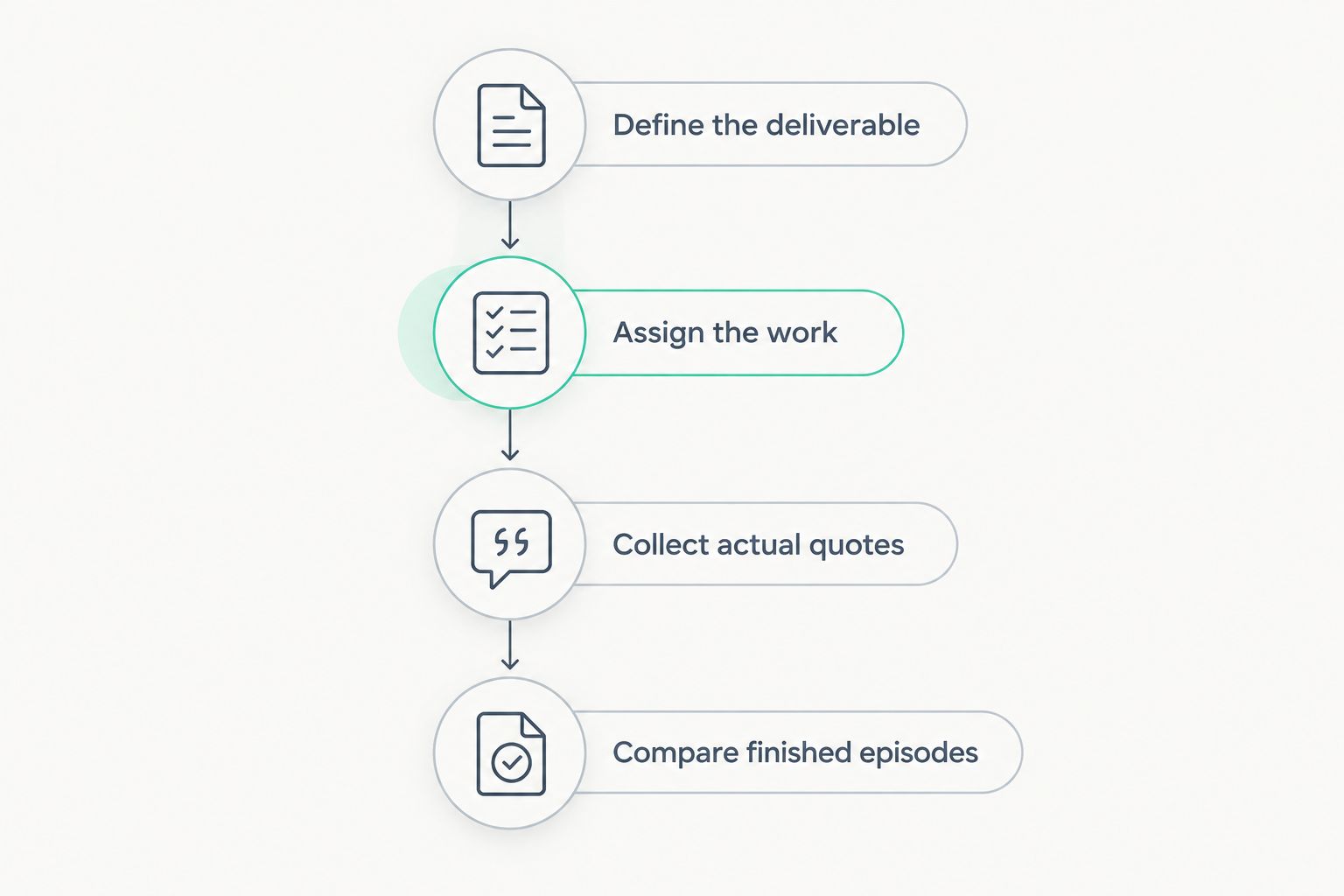
Compare the same finished deliverable before choosing equipment ownership or studio production.
Buying pays for itself when the production spending you avoid exceeds ownership costs over the same period. That calculation must include the production work still required after you buy the equipment.
Do not calculate payback from the equipment purchase alone while ignoring editing or workspace expenses. Also distinguish a cash break-even point from a workload you are willing to maintain.
Owning a microphone does not establish which route is cheaper. Compare the additional spending and work still needed to produce your planned episodes.
Keep usable equipment in the ownership calculation, but do not let an existing purchase dictate the entire production decision. Your 2026 plan should reflect what you need now, not just what you already bought.
Studio production is worth considering when the included services match work you want to delegate. Evaluate the recording support, branded set, editing scope, and delivery commitment against your business requirements.
It is a poor fit when you need spontaneous access to your own setup or prefer to control the technical process yourself. Choose the production model you can sustain, not the one with the longest equipment list.
What's cheaper: buying podcast equipment or renting a studio?
The cheaper option is the one with the lower total cost for the same finished episodes. Compare equipment, workspace, production labor, editing, and studio inclusions over the same publishing schedule.
Should I buy podcast equipment before I start recording?
Buy equipment after you define your format and decide who will handle production. A test recording in your intended space helps you assess the setup before committing to ownership.
Does renting a podcast studio include editing?
Studio rental does not establish whether editing is included; the written service scope does. Ask separately about recording support, file delivery, editing, and turnaround.
Can I save money by editing my own podcast?
Editing your own podcast removes an outsourced editing expense but adds work to your schedule. Compare the cash saving with the time and responsibility you are taking on.
Is a full-service podcast studio the same as a room rental?
A full-service podcast studio provides production services beyond access to a room. Compare the specific recording, staffing, set, and editing inclusions rather than relying on the booking label.
What does Dialed Studios include for entrepreneurs?
Dialed Studios offers done-for-you podcast and video production in Denver, including fully customized branded sets, a dedicated producer and engineer, editing, and content strategy. Its guaranteed 48-hour editing turnaround provides a defined delivery commitment.
What should I ask before choosing a podcast production option?
Ask who handles each production task and exactly which finished files you receive. Then compare the total cost, your workload, scheduling requirements, and editing commitment against the same brief.
Before you buy anything or book a session, write a responsibility list for your next episode. Put a person beside every task, from preparing the recording to checking the finished edit.
The empty spaces reveal what the equipment list leaves unanswered. For your 2026 decision, that is more useful than comparing microphones with a booking fee. If those tasks are what you want to delegate, assess Dialed Studios as a production partner—not a room rental.