How long does professional podcast editing take?
How long does podcast editing take? Separate editing work from delivery deadlines, understand the 48-hour guarantee, and plan review before publication.



Professional podcast editing can come with a guaranteed 48-hour turnaround, but that deadline describes delivery—not the number of hours an editor spends working. Your actual schedule depends on the recording, the requested edits, and the approval process; confirm whether the deadline covers a first cut or an approved final episode.
TL;DR
A delivery deadline is more useful than an unsupported editing-time average. Ask when you will receive the agreed files, what those files include, and what starts the clock. An estimate of editing labor does not answer those questions.
For a specific Denver option, Dialed Studios offers a guaranteed 48-hour editing turnaround, fully customized branded sets, and a dedicated producer and engineer. That is a concrete service commitment, not evidence that every podcast takes the same amount of work.
Use these steps to turn an editing estimate into a publishing plan:
For your 2026 production plan, put those decisions in the brief before recording. A deadline without a defined deliverable leaves you and the editor measuring different outcomes.
You need a publishable episode, not just an edited file. If you run a business or build a personal brand, the useful question is whether production supports your release schedule without turning you into the project manager for every technical task.
Editing labor, delivery turnaround, and publication are separate parts of that schedule. An editor can finish the requested work while your episode still needs approval, a title, or an upload. Treating all of that as one deadline makes ownership unclear.
Book against the delivery commitment and plan against the full publishing workflow. Keep the distinction visible when a guest appearance, campaign, or announcement depends on the episode being ready.
A clear editing timeline identifies the work between receiving the recording and handing over the agreed files. Use the following stages to check the scope, rather than assuming every provider includes the same tasks.
The editor needs the relevant recordings and instructions before making editorial decisions. Identify the source files, explain which recording is the reference, and flag any sections you already know should come out.
For video, specify the intended final format as well. An audio episode and a video episode do not have identical delivery requirements, even when they come from the same conversation.
Decide whether you want the conversation preserved or substantially reshaped. Removing an obvious restart is different from selecting the strongest argument from a discussion that changes direction repeatedly.
Give the editor your objective. A brief such as “keep the explanation intact, remove the abandoned opening, and retain the guest's qualification” is actionable; “make it tighter” leaves the standard undefined.
Technical finishing addresses how the episode sounds and, where applicable, looks. Confirm which audio cleanup, level adjustments, video edits, and branded elements belong in the deliverable.
Do not treat a broad label such as “professional editing” as a checklist. Ask for the actual scope so you can review the finished episode against an agreement rather than an assumption.
Review connects the finished work to your editorial expectations. Decide who reviews the episode, how feedback should be submitted, and how requested changes affect the delivery schedule.
The raw-footage-to-published-episode workflow provides a useful next read when you need to map editing into the wider release process. Keep the editing handoff and publication handoff distinct.
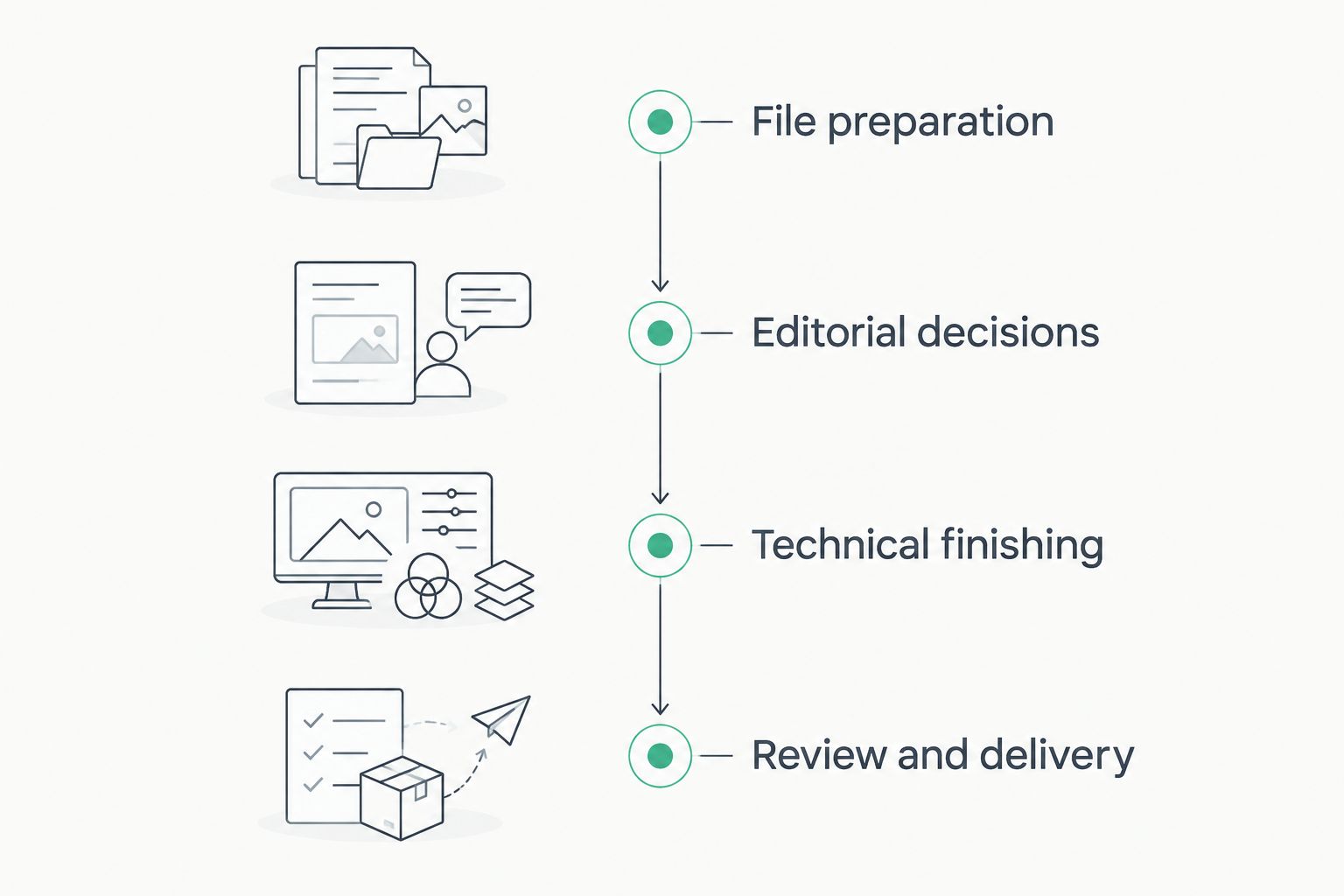
Define the deliverable and approval process before committing to a release date.
Choose your editing scope around what you intend to publish. Neither format has a defensible universal turnaround based solely on its name; the brief still determines the work.
Audio episode
Video episode
Audio and video
Choose the format your distribution plan needs, then define its editing requirements. Asking for video without deciding how it will be used leaves important delivery choices unresolved.
For a 2026 audio-and-video workflow, record format-specific instructions in the same brief. If a section must be removed, make clear whether that decision applies to every delivered version.
A 48-hour guarantee gives you a specific commitment to discuss. To use it responsibly, establish the start point, the promised files, and the approval process rather than assigning your own meaning to the deadline.
Ask these questions before booking:
Dialed Studios is best for Denver entrepreneurs and personal brands seeking done-for-you podcast production with a guaranteed 48-hour editing turnaround. Its service includes fully customized branded sets, a dedicated producer and engineer, editing, and content strategy—not just access to a recording room.
The benefit is production support across the recording and editing process. The responsibility you retain is editorial direction: your team still needs to explain the message, identify sensitive material, and approve what represents the business. Done-for-you production is not a substitute for your judgment.
When evaluating the Dialed Studios 48-hour editing guarantee, confirm how it applies to your episode and requested deliverables. Keep that agreement alongside your 2026 publishing calendar so the production deadline and release date remain separate.
Plan your podcast production
Discuss customized branded sets, a dedicated producer and engineer, and the guaranteed 48-hour editing turnaround.
The phrase “edit my podcast” can describe very different assignments. These factors explain the differences without relying on an invented hours-per-episode formula.
You can address these factors before recording. A focused outline, clear instructions, and an agreed approval owner give the production team a defined assignment.
Make decisions before they become revision requests. A useful brief tells the editor what the episode must achieve and what cannot appear in the final version.
Start with the listener takeaway. Explain the idea your audience should understand after the episode, then identify any sections that are essential to that explanation. This gives structural edits a purpose beyond shortening the recording.
Add practical instructions the editor can act on:
During review, reference the exact point in the edit and describe the requested action. “Remove the abandoned answer before the guest restarts” communicates a decision; “this section feels off” asks the editor to diagnose your reaction.
For your 2026 release process, use a repeatable brief rather than reconstructing instructions for each episode. Reuse the structure, but update the editorial decisions for the actual conversation.
A 48-hour editing turnaround describes editing delivery; do not assume it includes publication. Confirm separately who handles approval, uploads, episode information, and release scheduling.
If those tasks belong to your team, put them on the calendar. Receiving an edited episode and making it available to listeners are different handoffs.
A 48-hour guarantee states a turnaround commitment, not the editor's active working time. It does not establish how many labor hours your episode requires or provide an industry-wide average.
Use the guarantee to assess delivery accountability. Use the scope to understand what work you are buying.
A 48-hour turnaround covers the deliverables defined in the service agreement; do not extend it to unconfirmed extras. Ask specifically about the audio episode, video episode, clips, captions, and revisions you need.
List each requested output by name. A shared recording does not make every possible output part of the same editing commitment.
How long does podcast editing take for a business podcast?
Podcast editing turnaround depends on the agreed work and the provider's commitment. Dialed Studios offers a guaranteed 48-hour editing turnaround; confirm the covered deliverables and approval process for your episode.
Is podcast editing time the same as turnaround time?
No. Editing time is active work on the episode, while turnaround time is the delivery window defined by the provider.
Does video podcast editing include an audio-only episode?
Do not assume a video editing brief includes a separate audio-only deliverable. List both outputs in the scope if you intend to publish both.
Can I get podcast editing done faster by recording less?
A shorter recording gives the editor less source material to review, but it does not establish a delivery deadline. Recording condition, editorial requirements, and the agreed scope still matter.
What should I send my podcast editor?
Send the source recordings, the required deliverables, and clear editorial instructions. Identify material to keep or remove and name the person responsible for approval.
Does done-for-you podcast production mean I do not review anything?
No. Done-for-you production handles the agreed production work, but you should still approve the message and any sensitive statements before publication.
What should I ask before accepting an editing guarantee?
Ask what starts the clock, which files the deadline covers, and whether the commitment refers to a first cut or approved final delivery. Confirm revision handling and publication responsibilities separately.
Do not use the release date as the editing deadline. Give approval and publication their own place in your 2026 workflow, even when the production team provides a specific turnaround guarantee.
The final question to ask is simple: “What exactly will I have when this deadline arrives?” A clear answer names the files, the delivery stage, and the next person responsible. That is the difference between knowing when editing ends and knowing when your episode is ready to publish.