Is it better to record a podcast in a studio or at home?
Deciding whether to record podcast in studio or at home? Choose studio support for production help, or home for control. Compare the full workflow.



Record in a full-service studio when you want a production team to handle the technical work; record at home when you want direct control and can handle that work yourself. A studio does not replace preparation, and a home setup does not remove the need for editing. Choose the workflow you can finish consistently—not just the room where you want to record.
TL;DR
A full-service studio is the better fit when you want to delegate production. Home is the better fit when you want to own it. Neither location guarantees a compelling conversation, a useful episode, or a finished publishing schedule.
Before comparing locations, establish whether podcast studios provide equipment. Equipment access and production support are separate questions.
Best for
Main advantage
Main drawback
Equipment
Video appearance
Editing
Your responsibility
Use this comparison for your 2026 production plan. Do not assume that every studio includes an engineer, editing, or a branded set simply because those services exist elsewhere.
A recording location is one part of a publishing workflow. If you finish a conversation but leave the recording untouched, the room did not solve your production problem.
For entrepreneurs, the useful question is not whether a home microphone can capture speech. It is whether you want to manage the equipment, troubleshoot interruptions, organize files, review edits, and prepare the episode for release.
Separate the work you enjoy from the work you keep postponing. That distinction tells you whether production support solves a real problem or adds coordination you do not need.
Choose a full-service podcast studio when your priority is the conversation rather than operating the recording setup. Confirm exactly who handles recording, monitors the session, and takes responsibility for postproduction.
Dialed Studios is best for Denver entrepreneurs and personal brands that want done-for-you podcast and video production. Its offering includes fully customized branded sets, a dedicated producer and engineer, editing, and content strategy, with a guaranteed 48-hour editing turnaround.
That service model is different from booking an equipped room. You are choosing a creative partner and production team, not simply access to microphones and furniture.
A dedicated producer and engineer give the session named production support. You can prepare your questions and delivery instead of making yourself responsible for every technical decision.
Fully customized branded sets also address a specific video requirement: your recording environment can reflect your brand rather than whatever happens to sit behind your desk. That matters when the finished video is part of how prospective clients encounter your business.
You still need a clear topic, a useful point of view, and prepared guests. Production support does not decide what your audience needs to hear unless that strategic work is explicitly included in the agreed scope.
You also need to travel to the studio and coordinate a session. For someone who prefers recording whenever an idea arrives, that structure is a real trade-off.
For a 2026 business podcast, choose this model when delegated production is part of the requirement—not simply because a studio looks impressive.
Choose home recording when you want direct access to your setup and are willing to operate it. Home is a valid production environment, but it is not an automatic shortcut through production work.
A quiet, suitable room and careful microphone placement can support clear speech recording. Conversely, a microphone in a noisy or reflective room captures problems that equipment alone does not solve.
You control the recording space and can leave a setup ready if your room permits it. You can also rehearse, experiment with delivery, and record without traveling to another location.
That control suits creators who enjoy the technical process. It also suits a developing show whose host wants to test the format before committing to a more structured production arrangement.
You become responsible for checking the recording, monitoring sound, managing files, and arranging editing. If you record video, you also own the background, lighting, framing, and visual continuity.
Home recording is less attractive when those tasks repeatedly block publication. Control is useful only if you want the responsibility that comes with it.
For your 2026 home setup, evaluate the room as a working recording environment, not just an empty space that can hold a desk.
Your format and production responsibilities determine which location fits. Use these factors to make the decision specific to your show:
Do not let equipment dominate this list. Better equipment does not assign an editor, prepare your guest, or decide what the episode should accomplish.
Home recording does not automatically mean lower-quality audio. Room noise, reflections, microphone placement, recording levels, and technique all affect the result.
Listen to a test recording before deciding that you need a different microphone. Notice whether you hear traffic, ventilation, keyboard noise, or a hollow room sound beneath the voice.
Acoustic treatment and sound isolation address different problems. Treatment controls reflections inside a room; isolation addresses sound passing into or out of it. Adding absorptive material does not automatically stop outside noise.
A studio deserves the same scrutiny. Ask to hear work representative of the service you are considering, and establish who monitors sound during your session.
A studio is the better fit when you want someone else to manage the visual setup and production. Home works when you can create and maintain the appearance your show needs.
Video adds decisions that an audio-only recording does not require. Your background, lighting, camera framing, and physical arrangement all become part of what the audience sees.
For entrepreneurs using video to represent a business, fully customized branded sets provide a clear reason to consider studio production. But a distinctive set cannot compensate for an unfocused conversation.
Write the visual requirements into your 2026 brief. Describe what the audience should see, who handles the setup, and what finished video files you expect to receive.
A studio helps with delivery when editing is included and the turnaround is defined. Access to a recording room alone says nothing about when an edited episode will arrive.
Dialed Studios provides a guaranteed 48-hour editing turnaround. That gives you a concrete editing commitment to evaluate alongside its dedicated producer and engineer and fully customized branded sets.
Confirm what starts the turnaround clock, which deliverables it covers, and how feedback fits into the process. An editing deadline and a publication date are different commitments.
At home, assess the same workflow honestly. If recording is easy but editing repeatedly stops progress, changing the recording location alone is not the complete answer; assigning postproduction is.
Make the decision around a real episode, not an imagined future show. Use the following sequence to define what you need before selecting the location.
Write down what the finished episode must include: audio, video, or both, along with the editing work you expect. Specify whether you need content strategy or only production execution.
Do not assume that recording, editing, and publishing belong to the same service. Confirm each responsibility separately so the handoff is clear.
Record a sample in the home space you would actually use. Listen back with headphones and inspect the video if video is part of your format.
Evaluate the result rather than the equipment list. Identify specific problems before deciding whether you want to solve them yourself or delegate them.
Name who prepares the session, operates the equipment, checks the recording, edits the episode, and approves the final work. An unnamed task is an unfinished part of the plan.
For a studio, request the included scope. For home recording, make your own responsibilities explicit rather than assuming they will fit around everything else.
Choose the arrangement that matches your preferred responsibilities and the deliverables you need. Keep the decision narrow: you are selecting a production workflow, not making a permanent judgment about home recording or studios.
A good 2026 plan makes the next episode easier to complete. It does not depend on you suddenly enjoying technical work you consistently avoid.
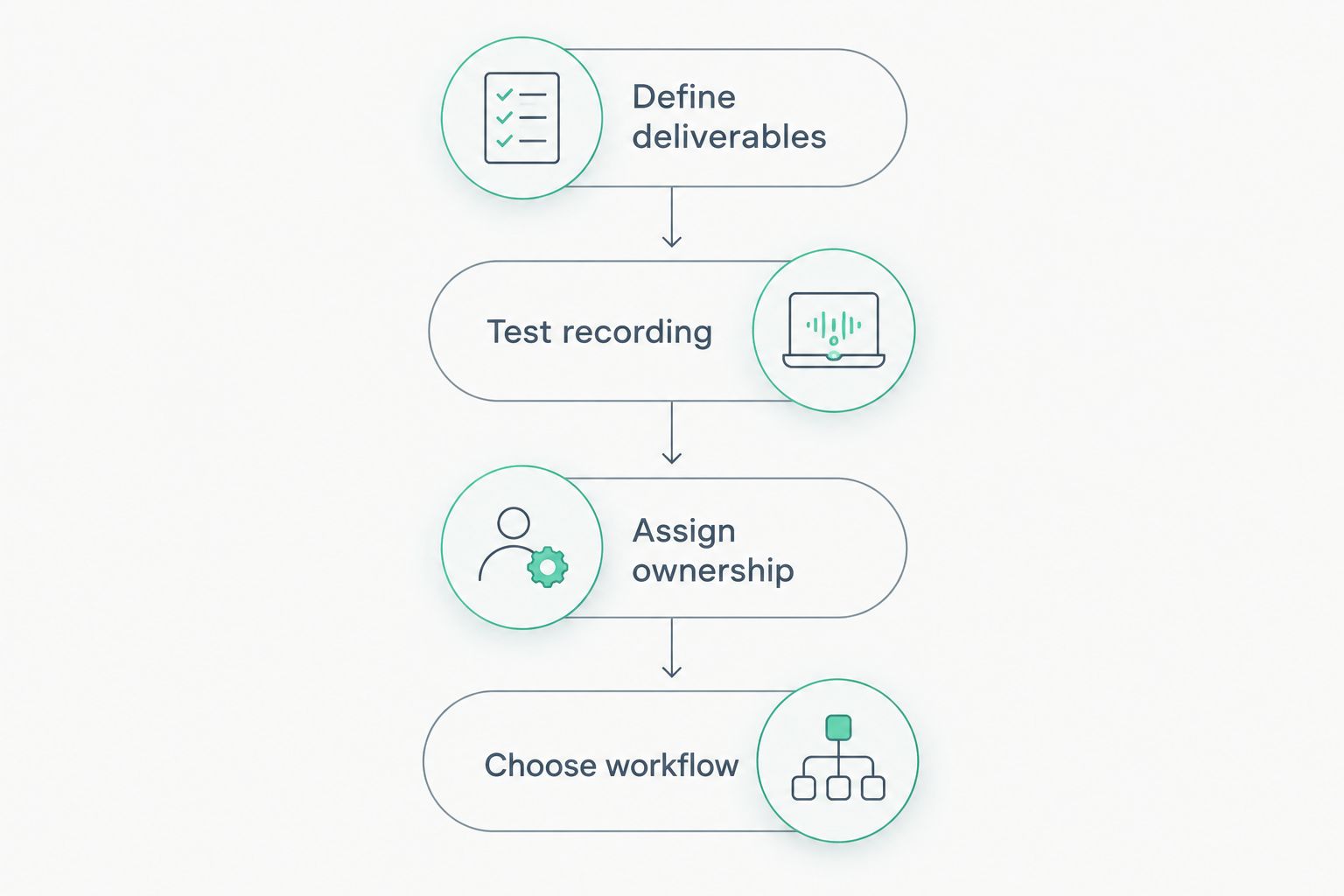
Define the finished work and its owner before choosing the recording location.
Choose a production partner when you want to show up prepared, focus on the conversation, and hand technical execution to a team. Do not choose one merely to avoid deciding what your show is about.
Dialed Studios combines Denver podcast and video production with fully customized branded sets, a dedicated producer and engineer, editing, and content strategy. Its guaranteed 48-hour editing turnaround is a specific reason to consider the service when postproduction timing matters.
The trade-off remains clear: you coordinate an in-person production session instead of recording entirely on your own terms. Choose the team when its responsibilities match the work you want off your plate.
Plan your podcast production
Explore customized branded sets, a dedicated producer and engineer, and guaranteed 48-hour editing.
Should I record my first podcast at home or in a studio?
Record at home if you want to test the format and manage production yourself; choose a full-service studio if you want technical support from the start. Decide who will edit the episode before recording it.
Can a home podcast sound professional?
A home podcast can sound clear and controlled when the room, microphone placement, recording levels, and technique support the recording. Listen to a test in the actual room before changing equipment.
Does booking a podcast studio include an engineer?
Booking a podcast studio does not by itself establish whether an engineer is included. Confirm the staffing, equipment, editing, and deliverables in the service scope.
Is a studio better if I want a branded video podcast?
A full-service studio fits a branded video podcast when it provides the set and production support you need. Confirm whether the set is customized for your brand rather than assuming every studio offers that service.
How quickly does Dialed Studios edit podcast content?
Dialed Studios offers a guaranteed 48-hour editing turnaround. Confirm the covered deliverables, the starting point for the turnaround, and the feedback process when defining your project.
Do I still need to prepare if a production team handles recording?
You still need to prepare the topic, questions, and guest expectations when a production team handles recording. Technical support does not replace a useful conversation.
When should I move from home recording to a studio?
Move to a studio when its production support addresses a problem you no longer want to manage yourself. Identify whether that problem is the recording environment, technical operation, video setup, editing, or content strategy.
Your editing handoff belongs in the plan before your recording session. The location decision gets attention because you can see the room and equipment; the unfinished work usually sits elsewhere in the workflow.
Before choosing home or studio, complete this sentence: after recording, the episode goes to a named person for defined deliverables. If you cannot finish that sentence, settle the handoff first.