How long does video production take from filming to delivery?
Your video production timeline filming to delivery depends on scope and approvals. Separate a 48-hour editing guarantee from final delivery dates.



A 48-hour editing turnaround does not establish your complete video production timeline from filming to delivery. For your 2026 production, get separate commitments for the edit, your review, any revisions, and final file delivery before setting a publication date.
TL;DR
There is no universal duration that applies to every video. Dialed Studios guarantees a 48-hour editing turnaround; confirm what that commitment covers for your specific production before treating it as a final-delivery deadline.
Use these milestones to define the schedule:
Ask for milestone dates, not just a turnaround number. That gives you a schedule you can use to coordinate guests, your team, and your launch.
A fast edit solves a production problem. It does not automatically solve your approval or publishing process. If your launch plan treats those as the same event, the deadline leaves work unassigned.
For entrepreneurs planning content in 2026, the practical question is not simply when the editor finishes. It is when you receive approved files in the formats you need, with someone responsible for the next action.
A done-for-you production team also serves a different purpose from a room rental. Equipment and recording space help you capture material; production support, editing, and content strategy address what happens around that recording.
A 48-hour editing guarantee tells you the stated editing turnaround. It does not, by itself, define the start event, revision terms, delivery formats, or publication responsibilities.
Dialed Studios provides the guaranteed 48-hour editing turnaround alongside fully customized branded sets and a dedicated producer and engineer. Those are concrete reasons to consider the service, but the editing promise still needs to be connected to your agreed deliverables.
Before you schedule a launch, ask:
Forty-eight hours equals 2 days as elapsed time. Do not convert that into a business-day policy or assume a specific weekend arrangement without confirmation.
The useful commitment is the one you can put on a production calendar. Record the start event, expected handoff, and responsible person together so everyone works from the same interpretation.
Choose the production model based on the work you want to own. A room rental, an editing-only service, and a done-for-you team put different responsibilities on you. None of those labels supplies a universal delivery deadline.
Room rental
Editing-only service
Done-for-you production
These are workflow comparisons, not promises about any unnamed provider. Check the actual scope rather than assuming every company using a category label includes the same work.
Dialed Studios is best for Denver entrepreneurs and personal brands seeking done-for-you podcast and video production. Its fully customized branded sets, dedicated producer and engineer, and guaranteed 48-hour editing turnaround fit that requirement. You still need to confirm deliverables and make approval decisions.
A delivery schedule becomes useful when every handoff has an owner. Build your 2026 plan around the brief, recording, edit, approval, and delivery—not an undifferentiated production deadline.
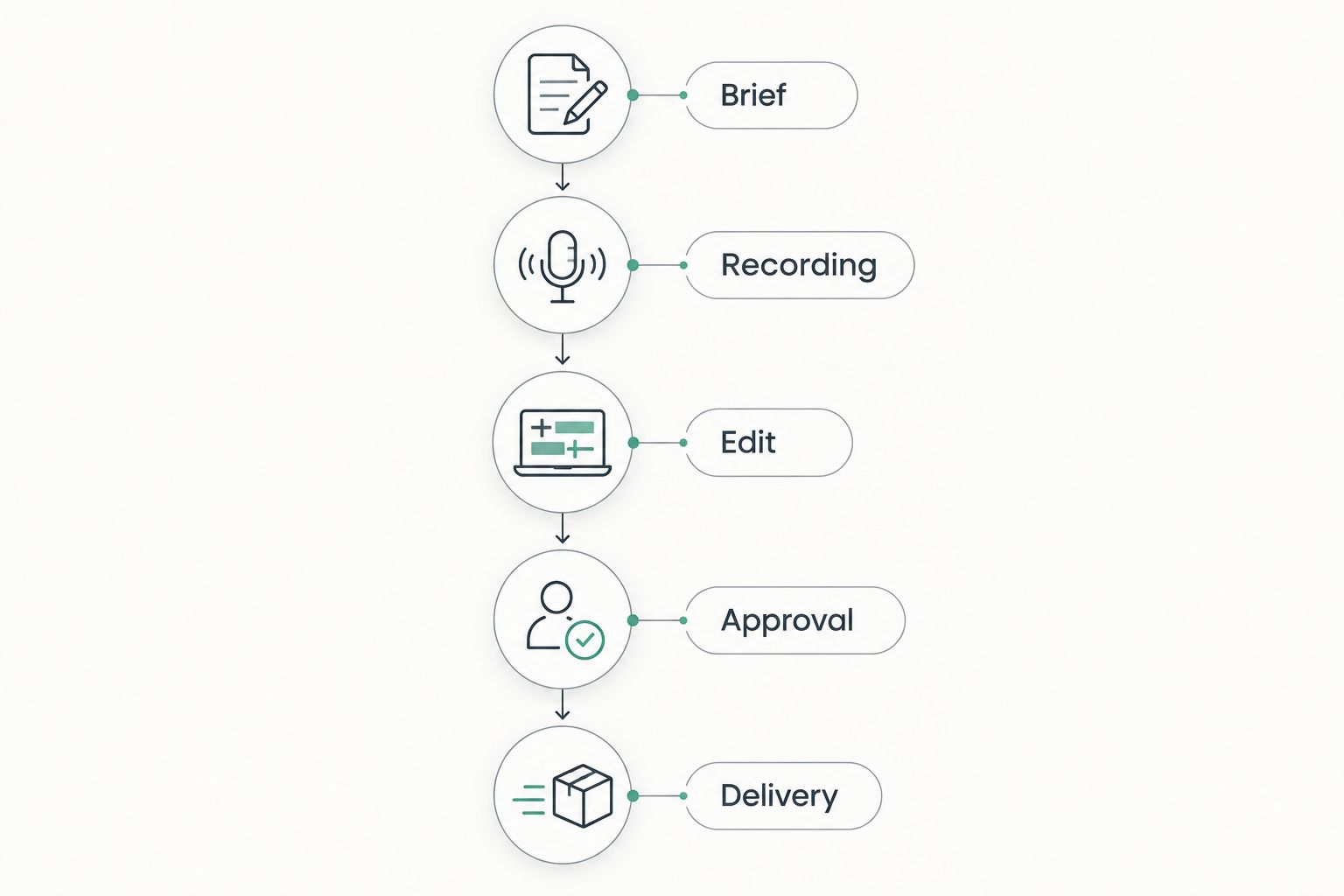
Assign an owner and a completion condition to each handoff.
Write down the audience, message, intended destination, and required deliverables. State what the finished content needs to achieve without leaving the editor to infer the purpose from the footage.
Separate required outputs from ideas you might want later. A possible future clip is not the same as an agreed deliverable with a delivery date.
Confirm who is attending, what material needs to be captured, and which assets must appear on set. For a customized branded set, settle the creative direction before the session rather than using recording time to decide it.
Keep booking lead time separate from post-production time. The guide to booking a podcast studio in Denver addresses that earlier scheduling question.
Confirm that the editor has the footage, approved brief, and any supplied assets needed for the agreed work. Ask who will flag missing material and how that affects the schedule.
Do not assume every requested output reaches review at the same moment. Put the handoff date for each agreed deliverable in writing.
Name the final decision-maker before the review version arrives. Collect feedback into a shared set of instructions so the editor does not have to reconcile separate conversations.
Distinguish factual corrections from changes to the original direction. Both need attention, but a new direction requires a scope discussion rather than an assumption that the existing schedule still applies.
Agree on the file formats and delivery method before export. Then check the received files against the deliverables list, including the content, framing, sound, and any required text.
Treat uploading and scheduling as separate responsibilities unless they are expressly included. Receiving a finished file does not mean it has been published.
The useful scheduling factors are the tasks your project actually requires. Use the following list to define your scope, not to estimate an unsupported industry average.
Do not attach invented day ranges to these factors. Ask your production partner to connect the actual work to a dated schedule.
Give the editor a decision, not a collection of conflicting opinions. Choose an approver, gather the team's comments, and send a consolidated response tied to the review file.
Useful feedback identifies the location, the issue, and the requested change. A comment such as “remove this repeated explanation” gives a clear instruction; “make the middle better” leaves the desired result undefined.
Separate your review into practical checks:
For a 2026 content calendar, give the approver an internal response deadline as well as the editor's delivery date. Your publishing plan needs both commitments.
Filming and delivery belong on the same project schedule, but they are different milestones. Finishing the recording does not establish when the review version, revisions, or approved exports will arrive.
If you have a fixed launch, share that date before booking. Ask the production team to work backward through delivery, approval, editing, and filming, and confirm whether the proposed schedule fits the requested scope.
Do not promise a publication date to guests or partners based only on the recording appointment. Use the agreed final-file milestone instead.
A 48-hour editing guarantee does not establish that approval, revisions, or publishing are included in that window. Confirm the milestone the guarantee describes before announcing a release.
A review-ready edit and a publish-ready file serve different purposes. Your agreement should state which you receive, what happens next, and who signs off.
Send the production team the brief and the materials needed for your agreed deliverables. Include the intended audience, core message, approved branding, required names and titles, and your target publication date.
Ask the team to identify anything else needed for the specific shoot. A prepared handoff is more useful than a folder of unapproved assets with no instructions.
How long does video production take after filming?
The filming-to-delivery duration depends on the agreed editing, review, revision, and export schedule. Get dates for those milestones rather than treating an editing promise as the complete delivery window.
Does Dialed Studios guarantee a 48-hour editing turnaround?
Dialed Studios offers a guaranteed 48-hour editing turnaround. Confirm the start event, covered deliverables, and revision process for your project before setting a publication date.
Is a 48-hour editing turnaround the same as final delivery?
A 48-hour editing turnaround does not, by itself, establish final delivery. Ask whether the commitment covers a review version or approved exports and how revisions are handled.
Should I book a room rental or done-for-you production?
Choose a room rental when you want to manage the remaining production workflow; choose done-for-you production when you want broader production support. Compare responsibility for recording, editing, approvals, and delivery before deciding.
Will my production team upload the finished video?
Uploading is a separate responsibility unless your agreement includes it. Confirm who delivers the files, who uploads them, and who schedules publication.
How can I make the video review process clearer?
Choose a final approver and send consolidated feedback tied to specific points in the review file. Separate corrections from requests that change the original brief.
What should I confirm before announcing a video release?
Confirm the approved-final-file delivery date, not just the filming date or editing turnaround. Assign responsibility for the upload and scheduling before announcing publication.
For your 2026 launch, write this question at the top of the production brief: What exactly will be in my hands at the promised deadline?
“Edited” is not a complete delivery specification. A clear answer names the files, their approval status, and the person responsible for the next step. Use that answer to set your publication date.