Do podcast studios assign a dedicated producer for every episode?
Need a dedicated podcast producer for every episode? Confirm staffing, creative support, editing ownership, and continuity before you book a studio.



No—booking a podcast studio does not, by itself, guarantee a dedicated podcast producer for every episode. Your agreement needs to specify producer coverage, responsibilities, and whether the same person stays with your show. Before you book, separate recording support from ongoing creative ownership and editing.
TL;DR
You should be able to focus on your guest without also managing the recording. But the word dedicated leaves an important question unanswered: dedicated to your session, your show, or the entire production process?
For your 2026 studio search, evaluate the handoffs as closely as the equipment. A producer assigned during recording is not automatically responsible for developing your interview, briefing an editor, or managing revisions afterward.
Dialed Studios is best for entrepreneurs and personal brands seeking done-for-you podcast production in Denver. Dialed Studios provides fully customized branded sets, a dedicated producer and engineer, editing, and content strategy. That makes the service a production partnership rather than simply access to a room; confirm the recurring staffing arrangement separately.
Not automatically. Treat producer assignment as a service commitment that needs a clear definition, not as an assumed feature of a studio booking.
Use the comparison below to specify the support you need. These are booking arrangements to ask about, not standardized packages that every studio offers.
Self-directed recording
Engineer-supported recording
Producer-led sessions
Ongoing production partnership
The distinction is practical. Someone can be dedicated to your recording without becoming the continuing creative lead for your show.
Ask who owns the episode before recording, during recording, and after the files leave the studio. A useful answer identifies responsibilities and handoffs. A job title alone does not.
Dedicated session support means you should establish who is assigned to your booking and what that person will handle. Ask whether the producer follows the conversation, flags unclear answers, manages the outline, or concentrates on session coordination.
This arrangement fits hosts who already have a clear format and mainly want support executing it. Its limitation is continuity: you should not assume that the person assigned today will return for your next episode.
Same-producer continuity is a separate commitment. If you want the same creative lead across your 2026 episodes, ask for that arrangement explicitly and ask what happens when that person cannot attend.
This fits a recurring show with established preferences, recurring segments, or an evolving editorial direction. The trade-off is dependence on an individual unless the studio also maintains usable production notes and a clear backup process.
End-to-end ownership concerns the workflow, not just the person in the room. Ask who turns the recording brief into editing instructions, gathers your feedback, and confirms the final deliverables.
This fits entrepreneurs who want to delegate production coordination. It does not remove your responsibility for business claims, guest choices, or final approval unless your agreement expressly assigns those decisions elsewhere.
Define the work before you evaluate the title. A useful producer brief identifies the decisions you want help making and the tasks you want off your plate.
Give the producer your intended audience, the episode's main question, and the action you want listeners to take. Ask who turns that information into an outline and whether guest preparation is included.
For an entrepreneur, the purpose should be more specific than discussing the business. You might want to answer a recurring customer question, explain a difficult decision, or challenge a misconception. Those are editorial choices you can make before anyone starts recording.
Tell the producer how you want interruptions handled. You might prefer immediate clarification when an answer is unclear, or notes saved until a natural pause.
Also separate creative intervention from technical monitoring. An engineer's recording responsibilities do not establish that someone is evaluating your argument, watching the episode structure, or prompting a missing explanation.
Ask who communicates the intended edits and who receives your feedback. Otherwise, a useful note made during the session can remain disconnected from the editing brief.
Establish which deliverables require your approval and where you should send consolidated feedback. A dedicated producer is most useful when the responsibility continues through a defined handoff—not when the title disappears as soon as recording ends.
Producer coverage depends on the work you request and the responsibilities the studio accepts. Use these factors to define the scope rather than assuming every booking includes identical support:
A detailed scope is more useful than a long list of equipment. Equipment supports the recording; the agreement establishes who does the work.
For a 2026 production plan, document these decisions before committing to a recurring schedule. That gives you a consistent basis for comparing proposals without treating unlike services as interchangeable.
Use this sequence to turn a broad promise into an actionable production brief. Ask for written answers that describe your arrangement rather than a general description of the studio.
The goal is not a complicated contract. You need a shared understanding of who does what, including the work that happens when you are no longer in the studio.
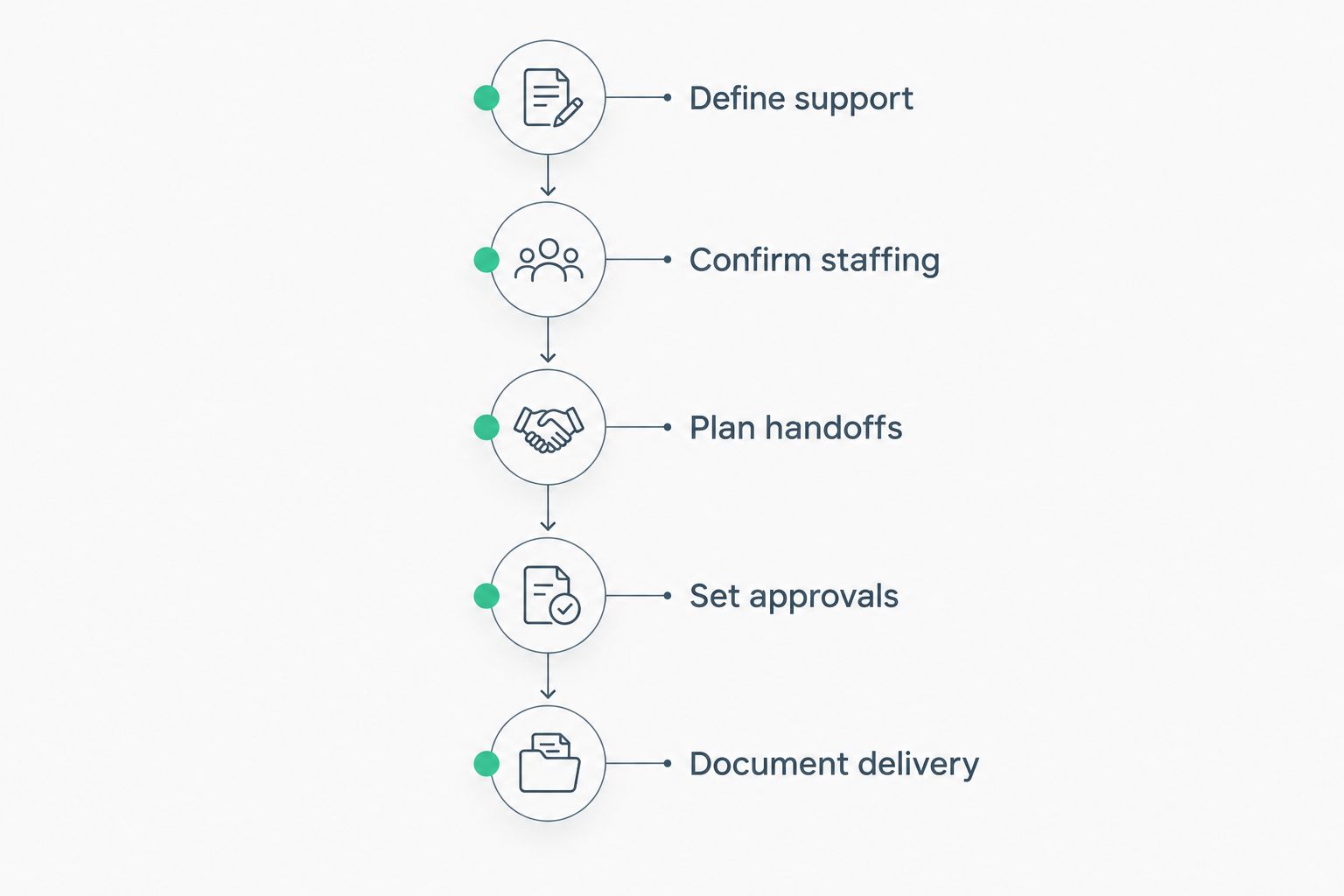
Confirm responsibilities and handoffs before committing to recurring sessions.
Ask the studio to walk through a hypothetical episode using your proposed scope. Start with the brief, follow the recording, and finish with your approval. Any unclear transition is a question to resolve before booking.
No. Producer coverage and engineering coverage describe different responsibilities, even when a particular arrangement assigns both kinds of work to one person.
For your 2026 booking, ask who manages the conversation and who monitors recording execution. You want responsibility to be explicit, particularly when you need support with both editorial decisions and technical operation.
Dialed Studios includes a dedicated producer and engineer in its done-for-you podcast production offering. Pairing that support with fully customized branded sets and guaranteed 48-hour editing turnaround addresses more of the production process than a room-only booking. Confirm how those responsibilities apply to your episode brief.
Not by definition. Producer assignment does not establish editing scope, content strategy, distribution support, or approval responsibilities unless the agreement includes them.
Ask about each deliverable separately. An edited episode, a publishing plan, and social content are different outputs; requesting one does not define the others.
A guaranteed 48-hour editing turnaround is a concrete delivery commitment, but you still need to confirm when the turnaround begins and what the guarantee covers. Do not treat an editing deadline as a promise about revisions, publishing, or every possible derivative asset.
For a 2026 release calendar, work backward from your intended publication date. Include your own review and approval steps instead of assuming the editor's delivery deadline is also your publishing deadline.
Choose the arrangement that removes the work you do not want to manage. If you enjoy directing the show and coordinating editors, session-level help can fit your process. If you want to arrive prepared to speak and delegate production execution, ask for a broader production partnership.
Dialed Studios combines content strategy, fully customized branded sets, a dedicated producer and engineer, and guaranteed 48-hour editing turnaround. The practical limitation is that done-for-you production still requires your input: your audience, your expertise, and your approval criteria cannot be inferred from equipment or a set.
Before enquiring, prepare a short brief with your format, audience, recording needs, desired deliverables, and expectations for producer continuity. Ask the team to explain which responsibilities it will own and which remain yours.
Define your production support
Discuss your episode format, producer coverage, customized set, and editing requirements.
Will I get a dedicated podcast producer for every episode?
Only rely on a dedicated podcast producer for every episode when your agreement explicitly includes that coverage. Confirm the responsibilities and whether the commitment means an assigned producer each session or the same person throughout your show.
Does dedicated mean I get the same producer every time?
No—the word dedicated alone does not establish same-person continuity. Ask for a clear recurring staffing commitment and the backup arrangement when your usual producer cannot attend.
What's the difference between a podcast producer and an engineer?
A podcast producer handles agreed editorial and production responsibilities, while an engineer handles agreed technical recording responsibilities. Ask the studio to identify the tasks assigned to each role rather than relying on titles.
Can a producer help me prepare interview questions?
Ask for interview preparation explicitly if you want help developing questions. Producer coverage during recording does not, by itself, establish that research, guest preparation, or outline development is included.
Does Dialed Studios provide a producer and editing?
Dialed Studios offers a dedicated producer and engineer, editing, content strategy, fully customized branded sets, and guaranteed 48-hour editing turnaround. Confirm the recurring staffing arrangement, deliverables, and guarantee terms for your production.
Does a dedicated producer publish the podcast for me?
Producer assignment alone does not establish publishing responsibility. Confirm who handles final approval, episode metadata, uploads, and release scheduling before assuming distribution is included.
What should I ask before booking recurring podcast sessions?
Ask who owns preparation, recording, editing instructions, approvals, and delivery for every episode. Then confirm staffing continuity, backup coverage, and how production notes transfer between team members.
Test the handoff, not just the room. Before you commit, ask what happens to an important editing note made halfway through a recording: who captures it, who receives it, and who checks that it was addressed?
That question makes responsibility concrete. The strongest production arrangement is the one whose responsibilities you can explain clearly before the first session begins.