Content strategy for business coaches: complete 2026 guide
Content strategy for business coaches works best around buyer decisions. Build a practical 2026 plan for podcasts, video, repurposing, and qualified inquiries.

.svg)
.svg)
Business coaches’ content strategy is a plan for turning your expertise into useful content that helps the right prospects understand your approach and take the next step toward coaching. Your content needs to show how you think—not just repeat business advice—and your production schedule needs to fit around client delivery.
TL;DR
Your prospects are evaluating your judgment. A motivational post tells them what you believe. A practical explanation shows how you diagnose a problem, weigh alternatives, and recommend action.
Build your 2026 content plan around decisions your ideal client needs to make. That gives each topic a business purpose without turning every post into a sales pitch. It also separates coaching content from generic entrepreneurship commentary.
Production is a separate decision. If recording support is your next bottleneck, compare podcast studios in Denver for business coaches against the work you actually need handled.
A business coach also has boundaries to protect. Client confidentiality limits which stories you can share, and coaching sessions cannot become raw material without permission. Your strategy needs useful examples that do not expose clients or imply results you cannot substantiate.
Start with a blank document. Write down who you coach, the problem they bring to you, and the decision that leads them to seek help. Use your existing inquiry notes and questions from sales conversations rather than inventing an audience profile.
Be specific about the situation. A founder struggling to delegate needs different content from an experienced executive considering a career transition. Both audiences care about leadership, but a broad leadership calendar hides the difference.
For your 2026 plan, choose one primary audience before adding secondary segments. This is a planning choice, not a rule that prevents you from serving other clients. It keeps your examples, language, and calls to action coherent.
Write a positioning sentence you can use to screen topics: this content helps a particular buyer make a particular decision. If a topic does not fit, move it out of the main calendar.
Build a simple spreadsheet before choosing publishing tools. Give each topic a buyer question, a clear answer, an example, and a next step. This is enough to turn scattered ideas into an editorial plan.
Use three topic groups as a starting structure: diagnosis, approach, and fit. Diagnosis content helps someone recognize a problem. Approach content explains how you work through it. Fit content clarifies who your coaching serves and what participation requires.
For example, a delegation topic can explain how to distinguish unclear responsibilities from a skills gap. A follow-up can show how you structure the conversation. A fit-focused piece can explain what a client needs to bring to coaching on that issue.
Do not mistake topic volume for a strategy. A large idea list without a buyer question still leaves you deciding what to say every time you sit down to record.
Start manually with the equipment you already have. Record a test explanation, review whether the message is clear, and decide whether you can repeat the process alongside client work. Do not buy a production workflow before you have a usable topic structure.
Choose the format according to the explanation. A podcast supports a detailed conversation. A short video answers a narrow question. A written guide lets readers inspect an argument at their own pace. None replaces a clear point of view.
When production becomes the obstacle, Dialed Studios provides done-for-you podcast and video production in Denver, with fully customized branded sets, a dedicated producer and engineer, editing, and content strategy. The guaranteed 48-hour editing turnaround gives you a concrete production commitment to consider in your schedule.
Dialed Studios is best for Denver business coaches who want done-for-you podcast and video production. The limitation is straightforward: production support does not replace your coaching expertise or your responsibility to define the audience and offer.
Create the brief yourself in a shared document. A useful structure has four parts: buyer problem, main lesson, practical example, and next action. This gives you direction without forcing you to read a script word for word.
The brief should make the lesson understandable on its own. Instead of opening with a long introduction about your background, describe the situation the viewer recognizes. Then explain the distinction or decision that makes your answer useful.
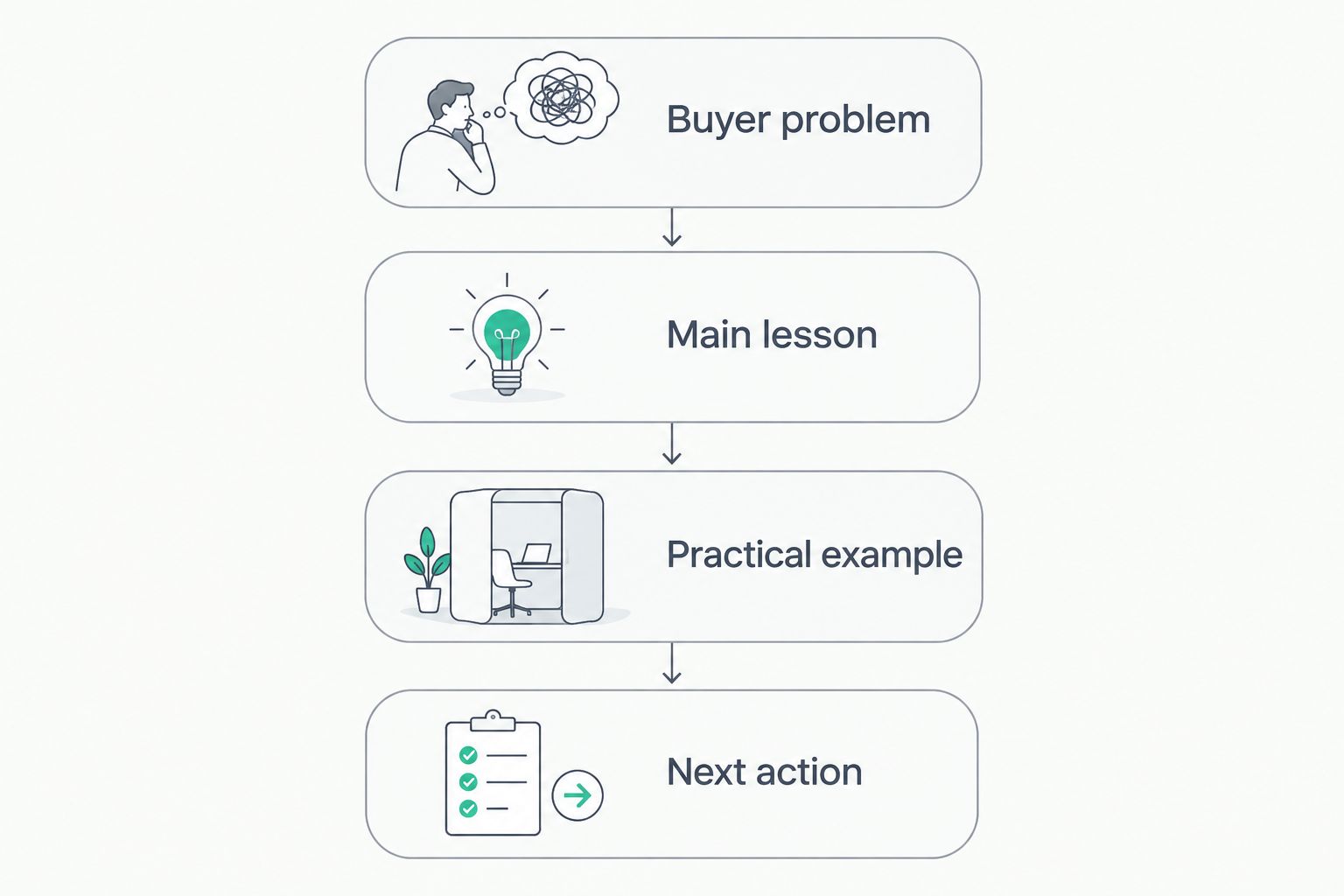
Plan the lesson before recording so the content answers a specific buyer question.
Set a 30-minute preparation block as an initial working limit, then adjust it to your material. This is a suggested schedule, not a benchmark. Use that time to verify claims, remove confidential details, and identify where an example needs context.
A dedicated producer and engineer can support production, but your brief still needs a defensible message. Fully customized branded sets support the presentation; they cannot supply the substance.
Start by reviewing the recording yourself and marking passages that answer complete questions. A strong excerpt contains enough context to make sense without the full episode. A dramatic sentence alone is not automatically a useful clip.
For your 2026 workflow, create a small repurposing checklist rather than promising an output count before reviewing the material. One explanation can support different formats, but each version needs its own opening, context, and next step.
Turn a spoken framework into a written checklist. Turn a complete answer into a short video. Use an email to explain why the issue matters to your audience. Keep the underlying recommendation consistent across those versions.
Dialed Studios provides editing and content strategy alongside production. Define the deliverables and approval process before recording rather than assuming every possible derivative format is included. The guaranteed 48-hour editing turnaround is not a reason to skip checking whether an excerpt preserves your meaning.
Write the call to action yourself before scheduling the content. Match it to the question you have answered. Someone learning to recognize a management problem needs a different invitation from someone actively evaluating coaching.
A next step does not always need to be a sales conversation. You can direct readers to another explanation, ask them to apply a diagnostic question, or invite an inquiry when the topic clearly concerns coaching fit. Use only destinations and resources you actually maintain.
Make the coaching invitation specific. Explain who the conversation is for and what question it helps address. Do not imply a guaranteed business result or promise a resource that does not exist.
Your 2026 calendar should distinguish educational content from direct offer content. That makes the purpose visible during planning and prevents every post from ending with the same unrelated invitation.
Start with a spreadsheet that records publication date, topic, format, and responses. Use available platform analytics alongside inquiry notes. Ask prospects what content they saw and what prompted them to reach out; record their answers without treating memory as precise attribution.
Review the plan after an initial 4-week publishing cycle. This is a suggested review interval, not a promised time to generate clients. The purpose is to identify production friction, unanswered questions, and content that attracts the wrong audience.
Separate attention from commercial relevance. Views show exposure. Substantive replies show questions or interest. Qualified inquiries show that someone fits your coaching audience and wants to discuss working together.
Change the topic or invitation before assuming you need more content. A polished publishing schedule is not useful if prospects misunderstand the offer. Keep production quality and buyer clarity as separate review items.
Choose the option that covers your bottleneck. If your message is unclear, fix the brief first. If recording and editing prevent you from publishing, compare production support rather than buying access to a room by itself.
Self-managed recording and editing
Room rental
Independent editing support
Dialed Studios podcast and video production
The comparison is about responsibility, not just recording quality. Ask who handles preparation, technical checks, edits, and approval. A clear division of work prevents gaps between recording an episode and publishing a useful asset.
Explore done-for-you production
Review Denver podcast and video production with customized sets and dedicated production support.
Generic advice does not explain your coaching approach. Replace a statement such as delegate more with a practical distinction: what should the owner clarify before transferring responsibility? Show the reasoning a prospective client needs to evaluate.
Anonymizing a name does not automatically remove identifying details. Build hypothetical examples or obtain appropriate permission before using client material. Label hypothetical situations clearly, and do not present them as client results.
Useful education and a clear offer belong together. Explain what you help clients work through, what participation involves, and where your scope ends. Do not expect an audience to infer those boundaries from your subject matter.
A fully customized branded set and clean editing improve presentation, not the underlying argument. Keep responsibility for audience selection and message approval explicit. Your production team needs a clear brief, not a request to make an undefined topic engaging.
What is content strategy for business coaches?
Content strategy for business coaches is a plan for creating and distributing expertise-based content that helps suitable prospects understand your approach and take a relevant next step. It connects buyer questions, formats, production responsibilities, and measurement.
What should a business coach post about?
A business coach should post about problems the coach is qualified to address and decisions the intended client needs to make. Explain your reasoning, use appropriate examples, and clarify when coaching is a suitable next step.
Is a podcast better than short videos for business coaches?
A podcast is better for detailed conversations, while short videos are better for focused answers. Choose according to the lesson and your ability to sustain production, rather than assuming one format serves every topic.
How often should a business coach publish content?
A business coach should choose a publishing schedule that fits preparation, production, approval, and client work. Test that schedule over a defined review period before increasing output.
Can I create coaching content without hiring a production team?
You can create coaching content yourself using your existing equipment and a clear recording brief. A production team becomes relevant when setup, recording, or editing is the bottleneck you need handled.
What does Dialed Studios offer business coaches?
Dialed Studios offers done-for-you podcast and video production in Denver, including fully customized branded sets, a dedicated producer and engineer, editing, and content strategy. The service includes a guaranteed 48-hour editing turnaround.
How do I measure whether coaching content is working?
Measure whether content produces relevant questions and qualified coaching inquiries, alongside platform engagement. Record what prospects say influenced their inquiry without treating that response as exact attribution.
Before adding another topic to your 2026 calendar, ask: would this explanation help a prospect decide whether my coaching approach fits their problem? If the answer is unclear, rewrite the brief before recording.
Production should remove execution work, not hide an unclear offer. Keep one responsibility with you: making sure the published lesson accurately represents how you think and whom you help.