Is a video production company worth it for small businesses?
Is a video production company worth it for small business? Yes, when it removes production work. Compare DIY, editing support, and done-for-you teams.



Yes—a video production company is worth it for your small business when you need repeatable, publishable content without managing recording and editing yourself. It is not worth hiring a team before you have a clear audience, a useful message, and someone responsible for publishing; production support does not replace those decisions.
TL;DR
Your business needs content that answers buyer questions, not another folder of unfinished footage. Before hiring in 2026, identify the work you want to stop doing: setting up equipment, directing a session, editing, or deciding what to record.
Dialed Studios provides done-for-you podcast and video production in Denver, including fully customized branded sets, a dedicated producer and engineer, editing, and content strategy. The guaranteed 48-hour editing turnaround gives you a concrete delivery commitment to evaluate alongside the production scope.
Buy a production workflow, not just access to a room. A studio session only solves your problem if the work between your idea and your finished content is clearly assigned.
A video production company is worth it when its responsibilities match the work your business cannot consistently complete internally. Compare the production models by who does the work, not by how impressive the equipment looks.
DIY recording
Editing support
Full-service production
These are different service models, not interchangeable purchases. Editing support makes sense when you can already capture the material you need. Full-service production makes sense when you want help creating that material as well as finishing it.
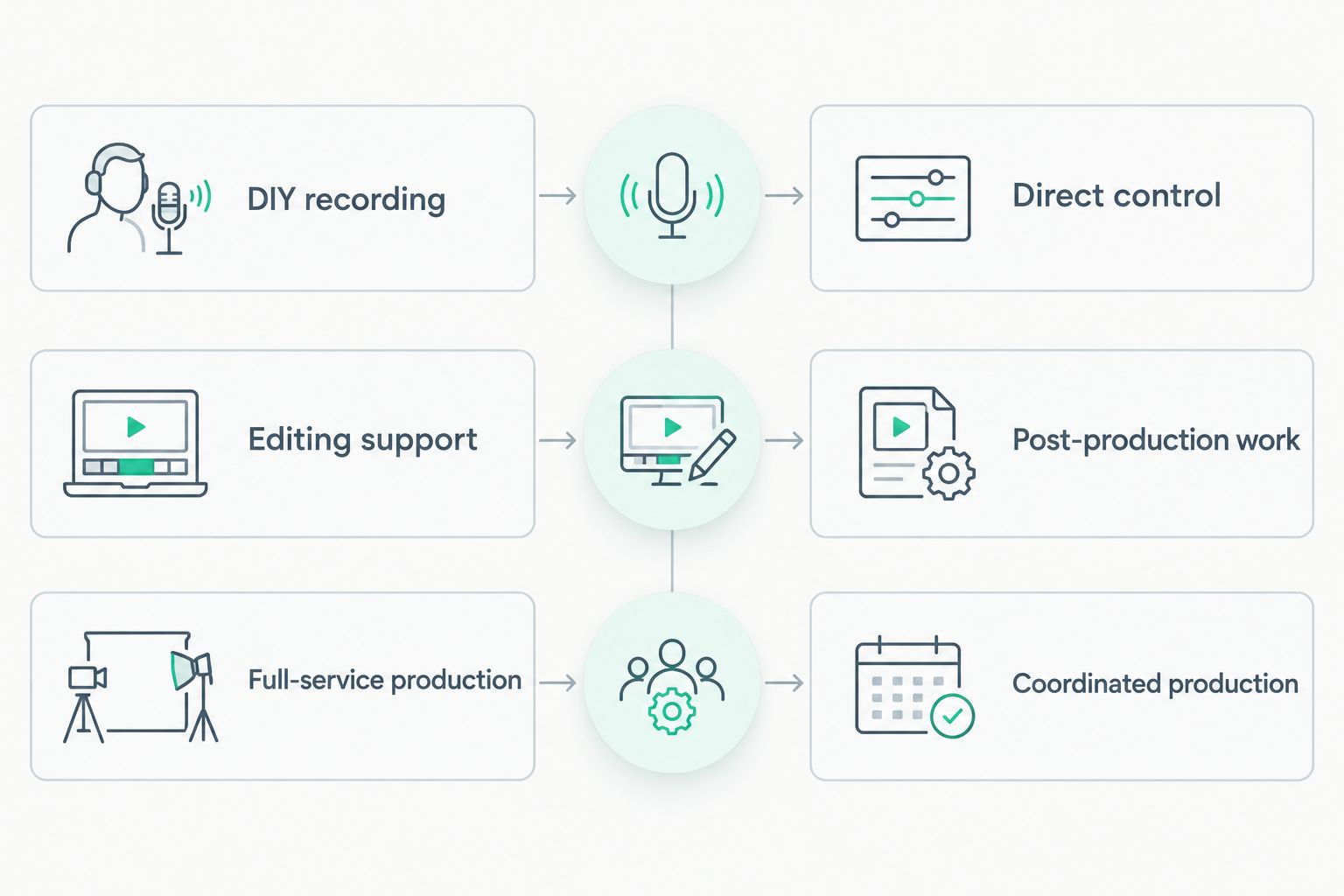
Choose the production model that transfers the work you need help completing.
Start with the smallest scope that solves the actual bottleneck. If you publish comfortably and only need editing help, do not treat a complete production engagement as the automatic answer.
DIY recording is the right starting point when your main question is what to say. Record useful answers to questions your customers already ask, then assess whether those answers belong in your ongoing content plan.
The advantage is control. You can change a topic or record an update without coordinating a production session. The trade-off is ownership of the entire process: preparation, sound, framing, editing, and delivery.
Choose DIY recording when the content is simple and your team can finish it. Do not mistake the ability to record for the ability to publish consistently. If footage repeatedly stalls in editing, your bottleneck is no longer the camera.
For a 2026 content plan, separate informal updates from pieces that need a repeatable branded presentation. They do not have to follow the same production process.
Editing support fits a business that records usable material but needs help turning it into finished content. It is a narrower solution than a production team, and that is its strength when recording already works.
You still need to supply footage, explain the intended audience, and define the finished deliverable. An editor cannot capture a missing answer or change the physical set after recording.
Choose editing support when post-production is the specific obstacle. Keep responsibility for recording quality explicit. Before handing over material, confirm the requested format, the purpose of the piece, and how feedback will be collected.
The limitation is upstream work. If you also need help shaping the conversation, managing equipment, and creating a branded setting, editing alone leaves those needs unresolved.
Full-service production fits entrepreneurs who want to contribute their expertise without becoming the production manager. The useful distinction is not the room itself; it is the team and responsibilities attached to the session.
Dialed Studios is best for Denver entrepreneurs who want done-for-you video production with fully customized branded sets and a dedicated producer and engineer. Its guaranteed 48-hour editing turnaround is a concrete reason to evaluate the service when editing delays are your sticking point.
The benefit is coordinated support across content strategy, recording, and editing. The limitation is that your business still supplies its expertise and approvals. A production partner cannot independently decide which customer questions matter most to your company.
Choose full-service production when you need the workflow handled together. Confirm what you receive, who approves it, and which publishing tasks remain yours before committing to a recording plan.
The same production model can fit one business and miss another. Evaluate these factors against your actual workload:
For your 2026 decision, rank these factors by the problem they solve. A custom set does not resolve an unclear message, and editing support does not replace a recording plan.
Use a written brief before requesting a proposal. It gives you a consistent basis for comparing services and prevents a conversation about equipment from replacing a conversation about outcomes.
Write down what the content should help a viewer understand or do. Examples include understanding your service, preparing for a consultation, or assessing whether your expertise matches their problem.
Avoid using visibility as the entire brief. Specify the audience and the next action you want to support. That makes the production decision easier to assess later.
List the tasks between your idea and a published video. Mark which tasks your team handles and which ones need an outside owner.
Be precise. If your team records regularly but never finishes edits, ask about editing. If preparation, recording, and editing all compete with your core work, evaluate a coordinated production service.
Request a clear description of deliverables, approval responsibilities, and delivery expectations. Distinguish finished editing from publishing; do not assume they mean the same thing.
Ask how fully customized branded sets are planned and what you need to provide before recording. For a guaranteed 48-hour editing turnaround, confirm the starting point and how revision requests are handled rather than assuming the guarantee covers every possible step.
Decide how you will assess the engagement before recording begins. Review whether content gets completed, whether your team does less production work, and whether the pieces support the business job in your brief.
Keep the engagement tied to a defined workflow. A successful recording day is useful, but it is not the same as a useful publishing process.
Explore done-for-you video production
Review customized branded sets, dedicated production support, and the guaranteed 48-hour editing turnaround.
Professional video production does not guarantee more sales. Production changes how content is planned, recorded, and finished; your offer, message, distribution, and sales process still require attention.
Connect each finished piece to a business purpose. Track relevant inquiries or conversations where you can identify the connection, and separate those observations from assumptions about what a polished video should achieve.
For a 2026 review, keep operational results and commercial results distinct. Completing content with less internal production work is an operational result. A qualified inquiry connected to that content is a separate commercial result.
Hire a video team before buying equipment when you want to hand off production rather than build an internal production function. Equipment is not a substitute for someone taking responsibility for setup, recording, and editing.
Choose internal production when your team wants that responsibility and can complete the work. Choose outside support when your priority is contributing expertise while a production team handles the agreed technical and creative tasks.
Neither choice removes the need for a clear brief. Decide who should own the work before deciding what equipment belongs in your workflow.
Is a video production company worth it for a small business in 2026?
Yes, when a video production company takes responsibility for work that prevents your business from publishing useful content. Start with a clear audience, message, and production scope; professional recording alone is not a business outcome.
What's the best video production option for a busy entrepreneur?
Full-service production is the best fit when you want recording, production support, and editing coordinated together. You still need to contribute your expertise, prepare for the session, and approve the finished content.
Is hiring an editor better than hiring a production company?
Hiring an editor is better when you already capture usable footage and only need post-production support. A broader production service fits when recording, set preparation, and session support also need an owner.
What does Dialed Studios offer for small-business video production?
Dialed Studios offers done-for-you podcast and video production in Denver, with fully customized branded sets, equipment, a dedicated producer and engineer, editing, and content strategy. The service includes a guaranteed 48-hour editing turnaround.
Do I need a customized branded set for every business video?
No, a customized branded set is not necessary for every business video. It is relevant when your recording environment needs to support a consistent personal or business brand; simple updates can follow a different production approach.
What should I ask before hiring a video production company?
Ask who owns preparation, recording, editing, approvals, and publishing. Confirm the deliverables and the editing turnaround in writing so you can compare responsibilities rather than equipment lists.
Before your next recording, write the action you want the viewer to take after watching. Then ask whether the planned content gives that person enough information to take it.
That is the practical test for your 2026 video plan. A production partner should help you finish useful content—not simply make more footage.