How long does it take to record a podcast episode in a studio?
Learn how long to record a podcast episode: plan beyond finished runtime. Separate setup, recording, and editing to book the right studio session.


Recording a podcast episode in a studio takes the time needed for your conversation, plus setup, checks, breaks, and any retakes; the finished episode length is not your booking length. Editing happens afterward, so confirm the recording window and delivery deadline separately before you book.
TL;DR
Your calendar needs a production appointment, not just a slot equal to your intended episode length. If you schedule another commitment immediately after the conversation, you leave no room for a microphone adjustment, an incomplete answer, or a closing pickup.
For your 2026 production calendar, separate time in the studio from time waiting for edited files. Dialed Studios provides done-for-you podcast and video production in Denver, including fully customized branded sets, a dedicated producer and engineer, and a guaranteed 48-hour editing turnaround. Those services cover different parts of the process; the editing guarantee is not a recording-session estimate.
Plan the session around the work you need to complete, not the runtime you want to publish. Your recording appointment includes preparation inside the studio, the actual conversation, and any material you need to capture before leaving.
Use this sequence to define the booking with your production team:
The first and second steps should begin before your appointment. The remaining steps still need space in your studio plan, even when the production team handles the technical work.
Do not assign a universal multiplier to finished runtime. A tightly prepared conversation and an episode requiring repeated corrections do not create the same recording workload.
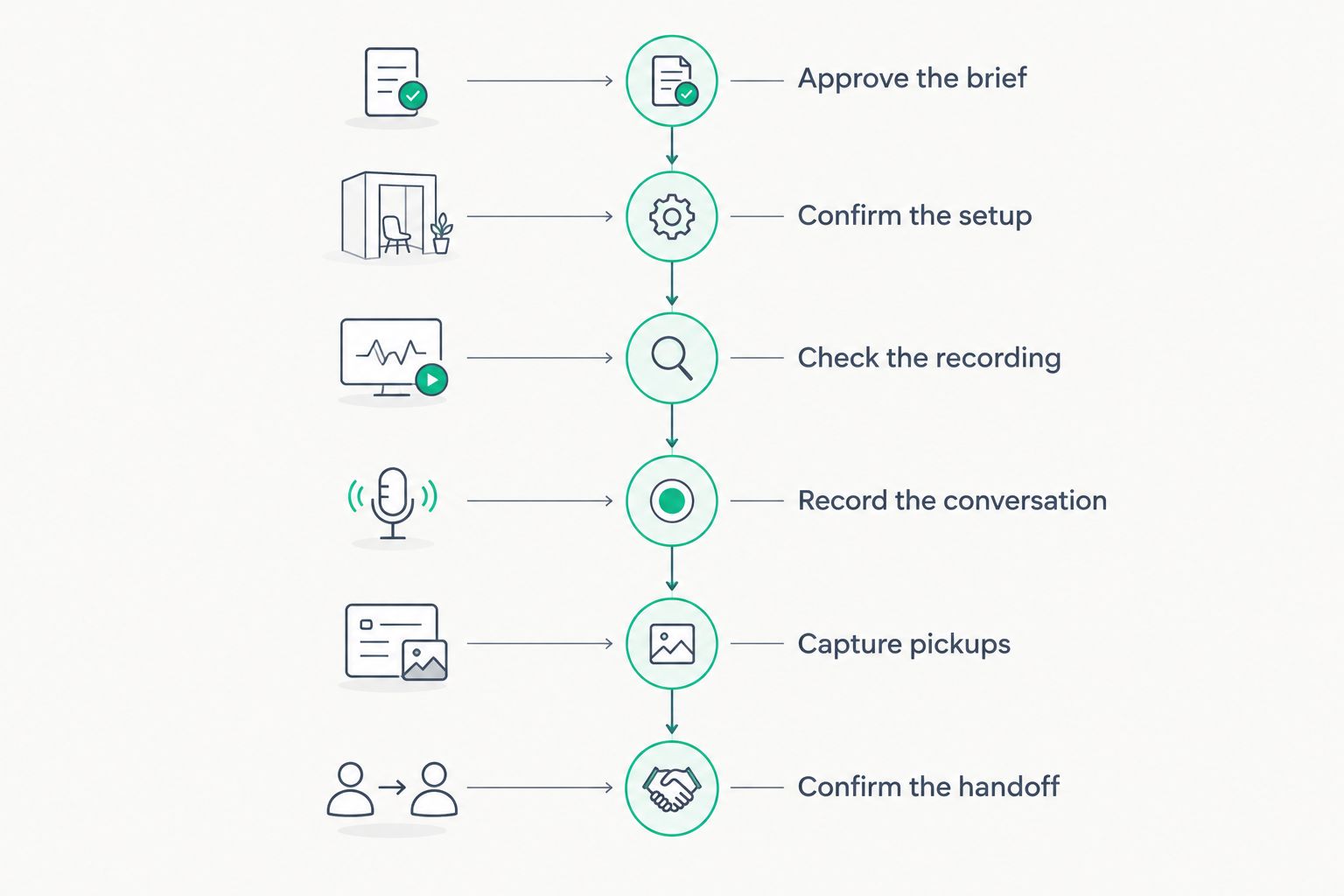
Plan the complete session, not just the conversation.
Finished runtime is the length your audience hears or watches. Recording time is the material captured during the session, including anything later removed. Your studio appointment also includes work that happens while you are not recording.
Editing turnaround starts after the recording stage under the agreed production terms. It does not describe how long you will sit at the microphone, and it does not automatically establish your publication date.
Finished runtime
Recording time
Studio appointment
Editing turnaround
Publication schedule
For a 2026 launch, put these milestones on separate calendar entries. A delivery commitment is useful only when everyone understands what is being delivered and what remains your responsibility.
Your format changes the work required inside the studio. Choose it around the episode's purpose rather than adding complexity because the equipment is available.
These are planning options, not claims that every studio provides every configuration. Confirm the scope with the team handling your recording.
Solo audio
Guest interview
Video podcast
A solo recording gives you control over the direction, but that control creates a preparation task. Decide what the listener should understand or do after the episode, then remove points that do not support that outcome.
Write the opening and closing before arriving. Use prompts for the middle if you speak more naturally without a full script. The aim is a clear delivery, not a perfect reading performance.
Send the guest the central topic, intended audience, and discussion boundaries. Make clear whether you want a practical explanation, a personal account, or a challenge to an established idea.
Leave room for follow-up questions. A rigid script can miss a useful answer, while an undefined conversation can wander away from the subject you invited the guest to discuss.
Treat the set as part of preparation, not an unrelated decoration decision. Share brand assets and visual references before recording, then confirm what needs approval.
Fully customized branded sets create decisions about what appears behind and around you. Resolve those choices with the production team before you need to concentrate on the conversation. Ask which approvals happen beforehand and which checks happen on arrival.
The useful question is not whether a studio can record quickly. It is which work must happen during your appointment and which decisions you can settle beforehand.
For recurring production in 2026, keep a session checklist and update it when your format changes. Reuse approved decisions, but do not assume a different guest or recording format needs exactly the same preparation.
A useful brief makes decisions explicit. It does not need to become a long presentation; it needs to tell the production team what you are trying to make.
Include the following:
Ask the team to confirm the proposed appointment length against that brief. A booking recommendation tied to your episode is more useful than an unsourced average.
Keep a separate list of optional material. If you want another introduction or a different closing, identify it before recording rather than remembering it after everyone has left.
Dialed Studios is best for Denver entrepreneurs and personal brands seeking done-for-you podcast production rather than a room rental. The service includes a dedicated producer and engineer, fully customized branded sets, editing, and content strategy.
That model fits when you want a creative partner handling production while you focus on the message and conversation. The trade-off is that a production team still needs your decisions: brand direction, episode priorities, and approval of the intended result do not disappear.
The guaranteed 48-hour editing turnaround gives you a concrete delivery commitment to discuss. Confirm its starting point, covered deliverables, and feedback process before attaching a public release date to it.
Plan your podcast session
Discuss customized branded sets, dedicated production support, and the guaranteed 48-hour editing turnaround.
Finished runtime alone does not determine the appointment. A conversation that needs little correction and a shorter episode that requires repeated takes involve different production work.
Give the studio your target runtime, but also explain the format and expected deliverables. Ask the team to account for setup, checks, pickups, and wrap-up rather than treating the target runtime as the complete booking.
Receiving an edited episode and publishing it are separate milestones. You still need to complete whatever review, upload, and scheduling tasks belong to your release process.
For your 2026 calendar, assign those tasks before recording day. Confirm who owns the episode title, description, final approval, and platform upload instead of assuming they are included in editing.
How long should I book a podcast studio for?
Book enough time for setup, recording checks, the conversation, pickups, and wrap-up. Send the studio your outline, format, and required deliverables so the booking recommendation reflects your episode rather than just its target runtime.
Does my podcast recording appointment include editing?
Recording and editing are separate production stages; your service agreement determines what is included. Confirm the editing deliverables and delivery terms before booking, even when the studio offers done-for-you production.
How fast does Dialed Studios edit a podcast episode?
Dialed Studios guarantees a 48-hour editing turnaround. Confirm when that commitment starts, what the delivery includes, and how feedback is handled when planning your release.
Will recording a video podcast require different preparation?
Video podcast preparation includes framing, lighting, appearance, and set decisions alongside audio checks. Approve the intended branded set before recording so visual decisions do not compete with your conversation.
Should I bring a full script to a studio podcast recording?
Bring a full script when exact wording is necessary; use an outline when you want a conversational delivery. Prepare the opening, main points, and closing either way so the episode has a clear direction.
Can I record several podcast episodes in the same appointment?
Discuss the complete batch with the production team before booking. Each episode needs a defined outline and deliverables, and the appointment must account for any changes in participants, setup, or presentation.
What should I confirm before booking a podcast session in 2026?
Confirm the appointment length, preparation responsibilities, recording format, deliverables, and editing deadline. Keep the recording appointment and publication date separate until you have assigned review and publishing tasks.
Before leaving the studio, check that you recorded a usable ending. A conversation can cover every planned topic and still stop without telling the listener what to take away.
Put the closing message in your outline and check it during wrap-up. For your next 2026 recording, make a complete episode the goal—not simply reaching the end of the booking.