Podcast studio rental for wellness coaches: complete 2026 guide
Podcast studio rental for wellness coaches: choose production support over an empty room. Compare sets, editing, and workflows for your Denver coaching brand.


Wellness coaches’ podcast studio rental is a production arrangement for recording useful conversations that introduce your coaching approach to prospective clients. For your 2026 podcast, choose a workflow that protects your message, handles technical work, and delivers publishable episodes; Dialed Studios offers done-for-you podcast and video production in Denver.
TL;DR
Your podcast needs to explain how you coach without turning every episode into a sales presentation. A useful episode answers a recognizable question, distinguishes education from individual advice, and gives the listener a relevant next step.
Choose the production workflow before choosing the room. An attractive set does not resolve unclear responsibilities for recording, guest preparation, editing, or approval. Your 2026 recording plan should identify who owns each task before you book a session.
Wellness content requires careful language. A conversation about routines, stress, or personal experiences needs enough context to avoid presenting an individual story as a universal result. Editing should preserve those distinctions rather than remove them for a shorter clip.
You also need to decide what the audience should understand about your practice. A coach teaching habit formation needs a different episode brief from a coach interviewing guests about their personal experiences. Start with that distinction, then choose the format and production support.
Video adds another decision: whether your surroundings reinforce your coaching identity or distract from the conversation. A fully customized branded set serves a different purpose from a shared room you simply occupy. Neither replaces a clear episode premise.
The practical goal is straightforward: leave the session with material that can move through editing and approval without rebuilding the message afterward.
Use the following sequence to separate editorial decisions from technical responsibilities. You can prepare the listener profile and episode outline yourself; bring in production support where recording, visual consistency, and editing require dedicated ownership.
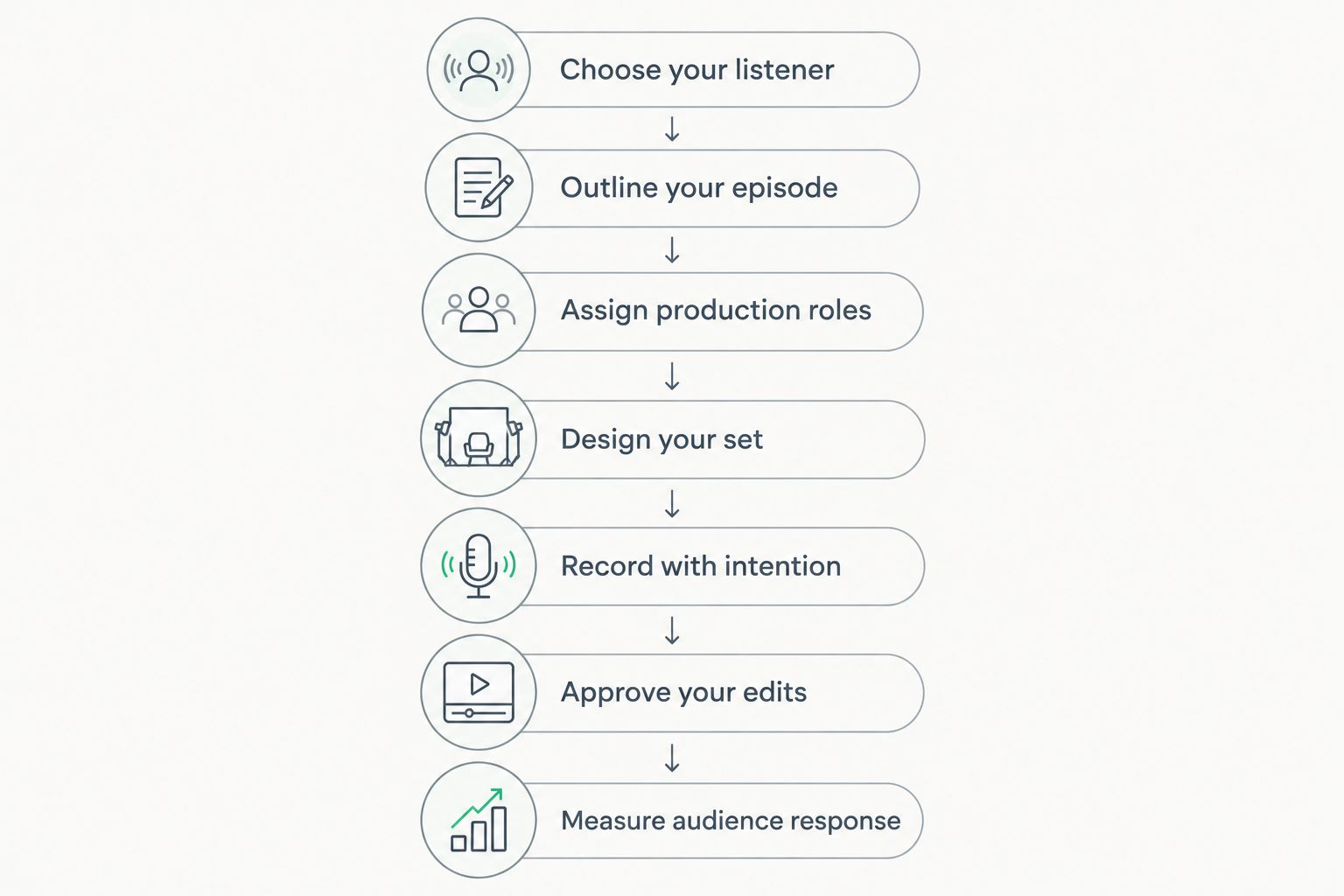
Set the editorial direction before handing off recording and editing responsibilities.
Write a listener brief before you reserve recording time. The manual approach is a simple document describing the person you want to help, the question they bring, and the limits of what an episode can answer. You do not need production software to make that decision.
Avoid defining your audience as everyone interested in wellness. Choose a situation instead: someone struggling to maintain a routine, someone comparing coaching approaches, or someone trying to understand what a coaching relationship involves. These are possible editorial directions, not promises about who will listen.
Give each episode one primary question. Related ideas belong in the outline only when they help answer it. This keeps your teaching focused and gives an editor a clear standard for deciding what belongs.
Prepare the conversation manually before adding production complexity. Use a shared document with an opening question, a teaching sequence, examples, and a closing invitation. For interviews, send the guest a topic brief rather than expecting a useful conversation to emerge without preparation.
For your 2026 launch, try a 20-minute rehearsal as a planning exercise, not a required episode length. Read the opening aloud, explain the central idea, and notice where you repeat yourself. Rewrite confusing transitions before the recording session.
A wellness interview also needs editorial boundaries. Decide whether the guest is discussing professional knowledge, personal experience, or both. Make those distinctions clear in your questions. Do not use a guest’s experience as proof that your coaching produces the same result for everyone.
The manual route is to assign recording, session management, editing, and publishing to yourself or named collaborators. Write those responsibilities down. Room-only rental works when you already have people who can handle the work outside the room.
The faster handoff is a done-for-you team with clear responsibilities. Dialed Studios is best for Denver wellness coaches who want podcast production with a dedicated producer and engineer rather than room-only rental. Its offering includes editing and content strategy, so the conversation can extend beyond access to equipment.
The trade-off is location and coordination. A Denver studio session requires you to arrange attendance and supply a useful brief. Production support does not remove your responsibility for accurate wellness statements, guest permissions, or final editorial decisions.
Start with a manual visual brief: describe the tone you want, bring approved brand materials, and identify anything that should not appear on camera. Your set should support the conversation rather than compete with it. A visually busy background does not explain your coaching approach.
Dialed Studios offers fully customized branded sets, which makes the setting part of the production brief rather than an unrelated rental backdrop. Discuss your intended presentation before recording. Do not assume customization includes a particular prop, material, or layout until you confirm the project scope.
For a 2026 video series, document the agreed setup so future episodes follow the same visual direction. Consistency is a production decision, not a reason to invent clinical-looking credentials or imply expertise your brand does not hold.
If you manage recording yourself, check the actual recording rather than relying only on how the room sounds. Capture a short sample, listen back, and inspect the picture before starting the conversation. Ask the production team to handle these checks when technical support is part of your arrangement.
Use a 60-second test recording as a practical pre-session check. Include normal speech from each participant and the seating positions you intend to use. This is a suggested workflow, not a claim about any studio’s standard procedure.
During the session, prioritize understandable teaching over a flawless uninterrupted performance. If an explanation becomes confusing, pause and restate it. For sensitive topics, correct the wording while the context is still fresh rather than leaving the editor to infer your intention.
The manual approach is to review the recording, prepare an edit brief, and return consolidated notes. Separate technical corrections from changes to the message. An editor can remove a distracting pause; you need to decide whether removing a qualification changes the meaning.
Dialed Studios provides a guaranteed 48-hour editing turnaround. Confirm the delivery and approval details for your project, then plan your own review around the handoff. Editing speed and editorial approval are separate parts of the publishing workflow.
For wellness content, review any excerpt as a standalone statement. A short clip should not turn a personal example into a treatment claim or remove the explanation that limits its meaning. Compare the proposed clip with the full discussion before approving publication.
Start manually with a simple publishing log. Record the episode topic, publication date, intended next step, and any attributable inquiries. Add platform analytics when you have them, but do not treat plays alone as evidence that the podcast supports your coaching business.
For your 2026 review, group episodes by the listener question they address. Look for responses that reveal understanding: thoughtful questions, relevant inquiries, or feedback about a specific explanation. Those observations help you decide what to clarify in the next recording.
Schedule a 30-minute review after a publishing cycle as a practical routine. Compare the episode brief with the response you actually received. Keep the next change specific: a clearer opening, a narrower question, or a more relevant invitation—not a complete format change without evidence.
Choose the option that matches the work you can reliably own. Equipment access, recording support, and finished editing are different services. Confirm the actual scope instead of assuming the word studio includes all of them.
Self-managed recording
Room-only studio rental
Separately managed production and editing
Dialed Studios done-for-you production
Choose room-only rental when you can own the remaining workflow. Choose done-for-you production when you want recording and editing responsibilities assigned to a team. Do not compare the options as if they deliver the same amount of work.
Plan your wellness podcast production
Discuss fully customized branded sets, dedicated production support, and guaranteed 48-hour editing turnaround.
A podcast cannot assess every listener’s circumstances. Keep general explanations distinct from recommendations that depend on personal information. Review guest statements with the same care you apply to your own teaching; an interview format does not remove your editorial responsibility.
Removing a name does not automatically make a detailed story unrecognizable. Use hypothetical examples when a real client account is unnecessary. If you plan to publish someone’s experience, settle permission and the intended use before recording or editing it into promotional content.
A polished room is not a production plan. Confirm who manages the session, who records, who edits, and who approves. A customized set becomes useful when the episode already has a clear audience and message.
A short excerpt can change the meaning of a careful explanation. Watch each proposed clip independently, then compare it with the full episode. Reject edits that remove a necessary qualification or imply a result you did not claim.
A listener asking how coaching works needs an explanation before an invitation. Answer the question fully. Then offer a relevant next step without implying that listening to the episode guarantees a personal wellness outcome.
What's the best podcast studio rental for wellness coaches?
The best fit is a studio workflow that matches the production work you need handled. Dialed Studios suits Denver wellness coaches seeking fully customized branded sets, a dedicated producer and engineer, and guaranteed 48-hour editing turnaround.
Is room-only rental better than done-for-you podcast production?
Room-only rental is better when you already manage recording and editing; done-for-you production is better when you want those responsibilities assigned to a team. Compare the included work, not just access to a room.
Do wellness coaches need a video podcast?
Wellness coaches do not need video to explain their coaching approach. Choose video when seeing the host, guest, or demonstration serves the episode, and account for framing and visual review in the production brief.
What should I prepare before a podcast studio session?
Prepare a listener question, an episode outline, guest permissions, and a clear production brief. Identify sensitive subjects and statements requiring verification before you record.
How do I keep wellness podcast clips accurate?
Approve each clip as a standalone statement and check it against the full conversation. Keep qualifications that distinguish personal experiences, general education, and individualized advice.
Can a production team write my wellness claims for me?
Production support does not replace factual review of your wellness claims. Assign a qualified reviewer where the subject requires specialist knowledge, and keep final approval responsibilities explicit.
How long should a wellness coaching podcast episode be?
Make the episode long enough to answer its primary question without unnecessary repetition. Test your outline aloud and cut material that does not help the listener understand the topic.
Ask yourself this before approving your next episode: Would the message remain accurate if someone heard only the strongest sentence? If not, rewrite that sentence or keep the necessary qualification beside it.
For your 2026 series, put that check in the approval brief. A fast editing handoff is useful only when the finished conversation still says what you mean.