Podcast editing for authors: complete 2026 guide
Podcast editing for authors should preserve your voice and meaning. Learn how to brief an editor, review excerpts, and choose the right production support.


Podcast editing for authors is the process of shaping recorded conversations into clear, accurate episodes that introduce readers to your ideas and books. This 2026 guide shows you how to preserve your voice, prepare useful editing notes, and choose between editing yourself, hiring an editor, and working with a production team.
TL;DR
A reader can reread a difficult paragraph. A podcast listener needs the idea to make sense as it unfolds. Editing should remove distractions without stripping away the phrasing, pauses, and stories that make your voice recognizable.
Authors also need editorial accuracy. A shortened answer can change a character's motivation, detach advice from its qualification, or reveal a plot point you intended to protect. The strongest edit makes your meaning easier to follow, not merely faster to consume.
For authors recording in Denver, Dialed Studios offers done-for-you podcast and video production with fully customized branded sets, a dedicated producer and engineer, and guaranteed 48-hour editing turnaround. Dialed Studios is best for Denver authors who want podcast production handled by a team rather than renting a room. You still own the editorial decisions: what the episode says, which excerpts need permission, and what listeners should do next.
Use the same editorial process for solo episodes, guest interviews, and book discussions. The recording format changes, but your priorities remain clear meaning, accurate references, and a useful listening experience.
Start with a written brief before opening an editing application. Name the intended listener and the question the episode answers. A conversation for existing readers needs different context from an introduction aimed at people who have never encountered your work.
Choose the outcome before choosing the cuts. An episode explaining your research should retain the reasoning behind your conclusion. An episode introducing a novel should explain its premise without giving away the resolution.
For your 2026 editorial calendar, connect each episode to a specific reader need rather than publishing a series of general book promotions. Edit toward understanding first; place the promotional request after the listener has received something useful.
Listen to the raw recording before making cuts. Use headphones and note where speech becomes difficult to understand, where speakers interrupt each other, and where the conversation loses direction. Keep an untouched copy so you can recover material after a mistaken cut.
If you record yourself, capture a short test and listen back before starting the full conversation. Adjust the room and microphone position before relying on corrective processing. Editing cannot reconstruct a word that was never captured clearly.
When you want recording and editing handled together, a done-for-you team provides a different service from a room rental. Dialed Studios supplies studio equipment, fully customized branded sets, and a dedicated producer and engineer. Your preparation then centers on the subject, guests, and editorial brief rather than managing the recording setup yourself.
Try a manual edit before handing off the process. Cut one repeated answer, tighten one transition, and compare the result with the original. That exercise helps you explain what you mean by natural pacing and identify which decisions you want to retain.
Self-editing puts every decision in your hands, but you also handle the technical work. An independent editor separates post-production from recording. A full-service production team combines recording support and editing, with the exact deliverables established in your brief.
Choose responsibility coverage, not just an editing label. If you need help planning and recording a video podcast, an audio-only editing arrangement leaves those jobs with you. The guide to audio editing software for podcasters is a useful next step if you plan to manage the edit yourself.
Make the structural edit first. Remove unrelated tangents, repeated explanations, and setup that no longer serves the episode. Then check transitions. A clean cut is not enough if the next answer assumes context you removed.
Keep qualifications attached to the claims they explain. If you discuss a historical interpretation, research finding, or personal experience, do not shorten the answer into a broader claim than you intended. Preserve the distinction between your opinion and material attributed to someone else.
For fiction, decide whether the conversation is spoiler-free before editing. For nonfiction, preserve the limits of your advice. Read excerpts against the source text and flag deviations that change meaning rather than treating every spoken variation as an error.
After the structure is settled, listen for distracting noise and uneven speech levels. Apply corrections cautiously, then compare processed speech with the original. The aim is intelligibility, not a voice that sounds detached from the person speaking.
Do not remove every breath or hesitation automatically. A pause before discussing grief, a laugh during a character anecdote, or a deliberate silence after an excerpt can carry meaning. Delete distractions; keep expression.
Build a short style note for whoever edits your 2026 episodes. Describe whether your show should feel conversational, tightly narrated, or somewhere between those approaches. Include a passage that represents the pacing you want, so the preference is audible rather than abstract.
Choose clips by listening for a complete idea, not simply a provocative sentence. The excerpt should make sense to someone who has not heard the full conversation. Add enough context to identify the subject without turning the clip into a second introduction.
Check captions against the audio. Author names, character names, unusual terminology, and book titles deserve a separate accuracy pass. If a caption changes a word, it can change the point even when the underlying recording is correct.
For a video podcast, plan your set before recording. Fully customized branded sets are part of Dialed Studios' production offering, alongside a dedicated producer and engineer. That supports an author-led visual presentation, but the set does not replace a clear premise or a well-prepared conversation.
Create a written approval route, even when you are the only decision-maker. Separate corrections to meaning from preferences about pacing. Give the editor a timestamp, the issue, and the requested change rather than a general instruction to make the episode better.
Dialed Studios guarantees a 48-hour editing turnaround. Build your 2026 release plan around that stated turnaround while confirming its scope and allowing time for your own review. Do not treat an editing deadline as automatic approval of the finished episode.
Use this sequence for every release. It keeps editorial judgment ahead of scheduling and makes the handoff easy to repeat.
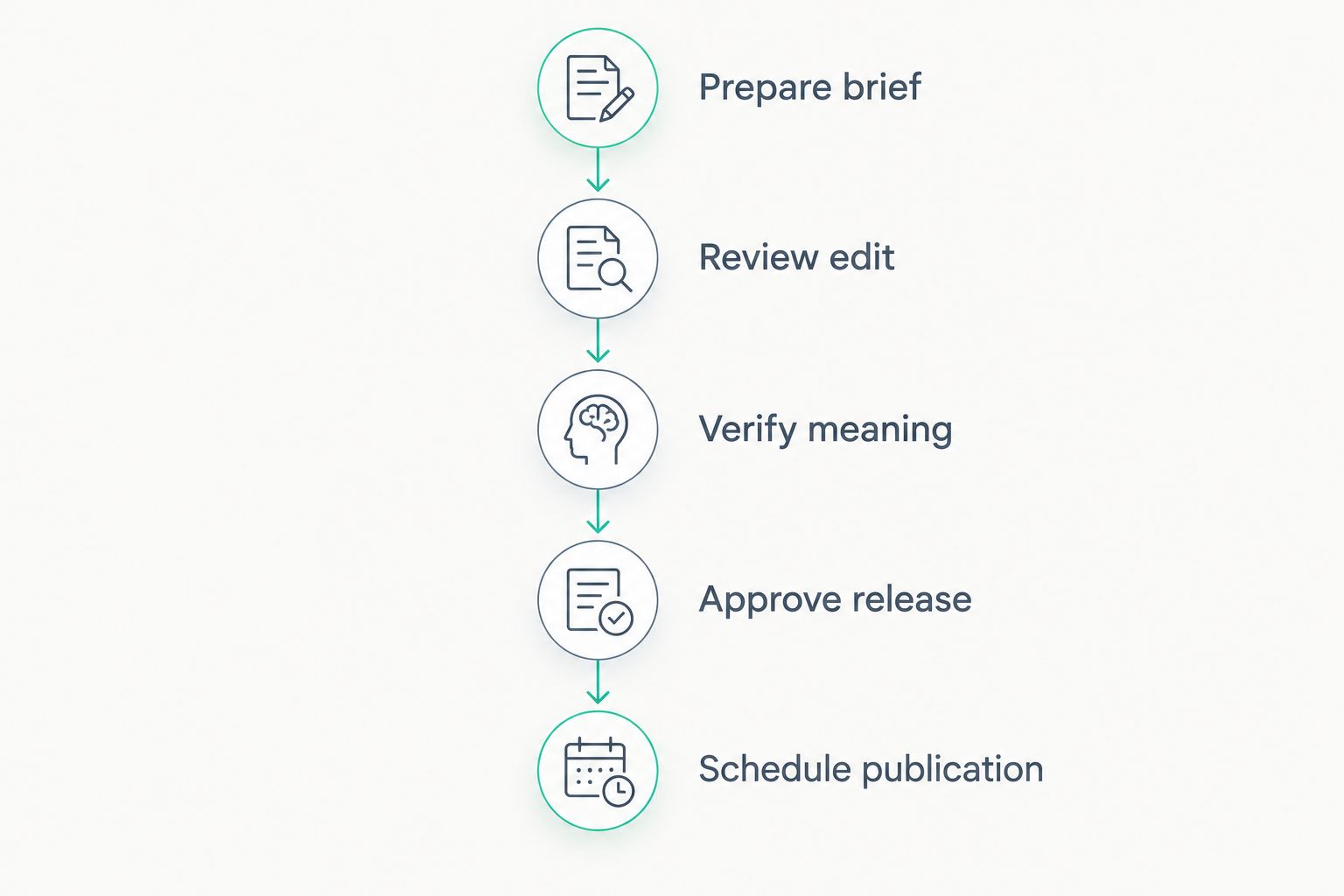
Verify meaning before approving the episode and scheduling its release.
Self-editing is best for direct control; an independent editor is best for post-production help; full-service production is best for handing off recording and editing together. None removes your responsibility to approve the meaning of the finished episode.
For your 2026 production plan, compare the work each arrangement covers. A room, an edited recording, and a done-for-you production service are different purchases. Ask who owns the tasks between arriving to record and approving the final files.
Self-editing
Independent editor
Dialed Studios full-service production
Room rental with separate editing
Before choosing, write down what you want to stop doing yourself. If the answer is only editing, a post-production arrangement fits that need. If it includes setup, recording support, and content strategy, compare production teams on those responsibilities.
Repeated promotion crowds out the reason to listen. Build the episode around a question, story, or useful explanation, then give the listener one relevant next step. Let the episode demonstrate your thinking before asking for the sale.
A concise excerpt can become inaccurate when it loses a condition or exception. Review the full episode and every standalone clip for meaning. Keep the sentence that explains when your advice applies, even if it makes the excerpt less punchy.
Speech uses pauses, repetition, and emphasis differently from written text. Cut repetition that stalls the conversation, but keep it when it helps the listener follow an unfamiliar idea. Judge the result by listening, not just reading a transcript.
An instruction such as tighten the middle leaves the editor guessing. Identify the passage, explain the problem, and specify what must survive the cut. Timestamped notes make disagreements about pace or meaning easier to resolve.
An editor can finish the file while an author still needs to verify an excerpt, check a name, or approve a guest's correction. Put approval into the schedule. A finished edit and a publication-ready episode are not the same milestone.
What's the best podcast editing approach for authors?
The best approach preserves your meaning while removing distractions. Choose self-editing for direct control, an independent editor for post-production support, or a full-service team when you also want recording handled.
Should I remove every pause and filler word?
No. Remove pauses and filler words that distract, but keep those that support emphasis, emotion, or a natural conversation. Listen to the edited passage before deciding whether the cut improves it.
How do I keep book excerpts accurate in a podcast?
Compare the spoken excerpt with the authorized source text before approving the edit. Check names, wording, attribution, and any permissions needed for material you do not control.
Is a podcast editor the same as a podcast producer?
No. An editor focuses on shaping the recorded material, while a production arrangement can also include planning and recording support. Confirm the responsibilities in writing because service scopes differ.
Can I turn an author interview into short video clips?
Yes, if you record video and select excerpts that stand on their own. Check captions, preserve necessary context, and remove spoilers you do not want new readers to encounter.
How quickly does Dialed Studios edit a podcast?
Dialed Studios offers a guaranteed 48-hour editing turnaround. Confirm the scope of that guarantee for your project and schedule your own editorial approval before publication.
What should I send with my podcast editing brief?
Send the episode's reader promise, the recording, timestamped notes, pronunciation guidance, and any passages that must remain intact. Include your intended publishing formats and identify who approves the finished files.
Review the closing request before reviewing the opening music. If listeners understand your ideas but cannot tell what to do next, the episode lacks a clear destination. For your next 2026 recording, write that destination into the brief before you press record.
Then protect the distinction between speed and readiness. Fast editing helps your schedule; accurate approval protects your voice. Publish the version you can stand behind, not merely the first version delivered.