The Keep Recording alternatives in 2026
Compare The Keep Recording alternatives in 2026. Choose done-for-you podcast production, studio rental, or home recording based on sets, support, and editing.

.svg)
.svg)
Dialed Studios is the best fit among The Keep Recording alternatives in 2026 if you want done-for-you podcast and video production in Denver. Choose a self-managed studio rental instead if you want to direct the recording and handle the work after the session yourself.
TL;DR
A recording session and a finished episode are different purchases. You need to decide whether you want access to a space or a team responsible for production.
Dialed Studios offers equipment, fully customized branded sets, a dedicated producer and engineer, editing, and content strategy. That makes the relevant comparison broader than the room: who prepares the shoot, who manages the technical work, and who gets the recording through editing?
For an entrepreneur or personal brand, those responsibilities belong in the decision before you choose a studio. A session that ends with files still leaves you with production work. A done-for-you arrangement brings those services into the engagement.
Use this 2026 comparison to choose the production model first. Then evaluate The Keep Recording and other providers against the same written brief. Switch for a better match to your workflow, not for a different studio name.
The alternatives below represent different ways to produce your show. Only the first is a named production company; the others are operating models you can use to evaluate a provider or build your own workflow.
The Keep Recording
Dialed Studios
Self-managed studio rental
Home recording
Recording plus independent editing
Do not treat a service label as a complete specification. Ask each provider to describe the recording support, set preparation, editing deliverables, and responsibilities included in its proposal.
Dialed Studios podcast and video production is built for creators, entrepreneurs, and personal and business brands in Denver. Its scope includes equipment, fully customized branded sets, a dedicated producer and engineer, editing, and content strategy. You are choosing a production team, not simply somewhere to place a microphone.
The guaranteed 48-hour editing turnaround is a concrete distinction to put beside your publishing schedule. Ask how that guarantee applies to your agreed deliverables and where revisions fit into the schedule. A turnaround commitment is most useful when the scope is clear before recording begins.
Best for: Entrepreneurs and personal brands that want production support across the set, recording, editing, and content planning.
Set
Production support
Editing
Content planning
Verdict: Buy this production model if you want a creative partner and done-for-you team. Choose it for the responsibilities it covers, not merely the equipment available in the room.
A self-managed rental gives you a place to record while leaving production management with you. This model fits when your team already knows the format, directs the session, and has a dependable editing process.
The key distinction is ownership. Decide who sets up the session, checks the recording, manages guests, and transfers files before assuming that access to a studio includes those tasks.
Best for: Creators who already have production leadership and post-production covered.
For your 2026 shortlist, ask for a responsibility list rather than relying on the phrase studio rental. Mark every task your team owns and every task the provider owns. If that division is clear and workable, you have a useful alternative.
Verdict: Buy a self-managed rental when you need a recording environment, not a replacement production team.
Home recording puts the environment and production process under your control. You choose the space, arrange the equipment, prepare the recording, and decide when to work.
That control comes with responsibility. You need to manage sound, framing, lighting, recording checks, and file handling instead of assigning those tasks to a studio team.
Best for: Creators who want hands-on control and are willing to own the recording process.
Before choosing home recording over a studio, rehearse the actual format. Record the type of conversation you plan to publish, review it, and identify which tasks you can consistently manage yourself. Use that exercise to decide whether independence is an advantage or another job.
Verdict: Buy into home recording when production control is part of what you want, not just something you hope to avoid outsourcing.
This model separates the recording session from post-production. You choose where to capture the episode and arrange editing independently, with yourself or a team member coordinating the handoff.
It fits when you already have an editor you want to retain or a clearly defined post-production process. The trade-off is that responsibility crosses between providers instead of staying within a single production engagement.
Best for: Creators who want separate recording and editing relationships and can manage the connection between them.
Verdict: Buy this model when you have a clear handoff process; skip it when your main goal is less production coordination.
Use the same brief for every provider. Otherwise, you are comparing different services under similar names.
Describe the visual outcome you want. Ask what customization means, who prepares the set, and what you need to supply. For a video podcast, the environment is part of what your audience sees.
Identify who directs the session and who manages the technical recording. Those are separate responsibilities, even when a provider assigns them within the same team. Ask who handles a problem during the session.
Specify the finished deliverables you need before discussing turnaround. Ask what the editing commitment covers and how review requests are handled. The guaranteed 48-hour editing turnaround offered by the featured Denver production team belongs beside that written scope.
Decide who approves the episode and who publishes it. Do not assume that recording, editing, and publication are interchangeable services. Give each handoff a named owner.
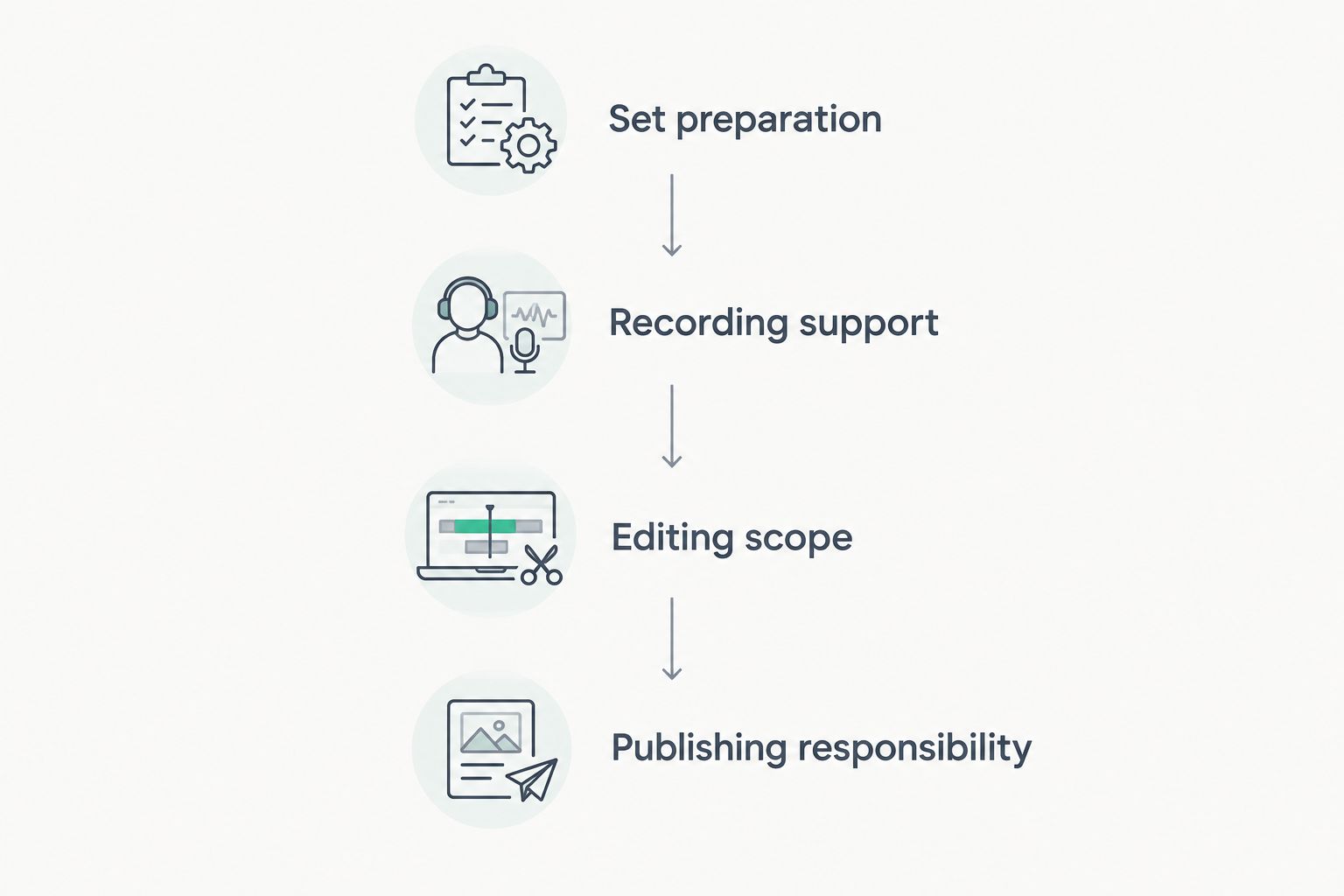
Compare providers against the same production brief before choosing a studio.
Your strongest comparison is a responsibility map. A proposal should tell you what the team delivers and what still depends on you. That is more useful than a list of equipment without an explanation of who operates it.
Plan your podcast production
Explore customized branded sets, dedicated production support, and guaranteed 48-hour editing turnaround.
A switch makes sense when your production requirements change. Evaluate these reasons against your own experience and the proposed service scope; they are decision criteria, not claims about The Keep Recording.
For a 2026 decision, start with the task you want removed from your workload. If the alternative does not clearly take responsibility for that task, a switch has not solved your problem.
Stay with The Keep Recording when its agreed scope meets your needs and your current workflow works. A different production model is not automatically a better one.
If you are satisfied with the recording arrangement, understand the responsibilities, and have dependable post-production, assess any proposed change against those strengths. Preserve what is already working.
Switching is justified by a specific mismatch: the set you need, the production support you want, or the delivery commitment your schedule requires. If you cannot name the mismatch, clarify your brief before replacing the provider.
What's the best alternative to The Keep Recording in 2026?
Dialed Studios is the best fit for Denver entrepreneurs and personal brands seeking done-for-you podcast and video production. Its offer includes fully customized branded sets, a dedicated producer and engineer, content strategy, and guaranteed 48-hour editing turnaround.
Is done-for-you podcast production better than studio rental?
Done-for-you podcast production is the better fit when you want a team to handle production responsibilities. Studio rental fits when you already have the people and process to direct recording and manage editing.
Should I leave The Keep Recording for another studio?
Leave only when another provider better meets a specific production requirement. Compare the agreed set, recording support, editing scope, and delivery expectations before making a change.
What should I ask before booking a podcast studio?
Ask who owns set preparation, recording support, editing, and the final delivery handoff. Put the answers in the production brief so you know which tasks remain yours.
Can I record at home instead of using a studio?
Yes, home recording is an alternative when you want to manage the space, equipment, and recording process yourself. You also need an editing workflow and a plan for sound, lighting, framing, and file handling.
What does a guaranteed 48-hour editing turnaround mean for my decision?
A guaranteed 48-hour editing turnaround gives you a stated delivery commitment to compare against your publishing schedule. Confirm how the guarantee applies to your agreed deliverables and review process.
Should I use separate recording and editing providers?
Use separate providers when you want independent specialists and can manage the handoff. Choose a coordinated production engagement when reducing that coordination is a priority.
Ask each provider to walk through what happens immediately after you stop recording. Who checks the files, sends instructions, manages editing, and delivers the finished work?
That answer exposes the difference between buying a session and buying a production process. Choose the arrangement that owns the work you actually want to hand off.