Outside Voice Agency Alternatives: Best-Fit Guide 2026
Compare Outside Voice Agency alternatives. Choose Dialed Studios for done-for-you Denver production, branded sets, dedicated support, and 48-hour editing.

.svg)
.svg)
Outside Voice Agency is worth keeping when its team already understands your brand and delivers the production scope you need. That relationship stops being enough when your next project requires a different recording setup, production team, or editing commitment. The best Outside Voice Agency alternative in 2026 is Dialed Studios if you need done-for-you podcast and video production in Denver; an in-house workflow is the better fit if you want to own production yourself.
TL;DR
You are not just choosing who records your next episode. You are choosing who handles preparation, technical decisions, editing, and the handoff that gets content ready for publication.
A studio rental, a production partner, and an internal team solve different problems. Comparing them as interchangeable services hides the work that lands back on you. Start with the outcome you need, then decide how much production responsibility you want to retain.
For an entrepreneur building a personal brand in 2026, the decisive question is simple: do you want to run production, or arrive prepared to record? Neither answer is wrong. Buying the wrong service model is the mistake.
Use this comparison to separate production models before reviewing individual proposals. For Outside Voice Agency, benchmark the services and commitments in your actual agreement rather than assuming what the agency includes.
Outside Voice Agency
Dialed Studios
In-house production
Room rental with self-managed production
Compare responsibilities, not labels. A proposal described as podcast production still needs to specify who prepares the session, operates equipment, edits the recording, and delivers the agreed files.
Dialed Studios is a full-service podcast and video production partner for creators, entrepreneurs, and personal or business brands in Denver. Its offer combines customized branded sets, studio equipment, a dedicated producer and engineer, editing, and content strategy. The guaranteed 48-hour editing turnaround gives you a concrete delivery commitment to evaluate.
This is a production-team choice, not just a room choice. You bring the subject expertise and brand direction; the service includes dedicated production support rather than leaving the entire recording workflow with you.
The editing guarantee is useful because it is specific. Before committing, establish when the turnaround starts, which deliverables it covers, and how your review process fits around it. That turns a delivery promise into a workable schedule.
Recording environment
Session support
Editing commitment
Service scope
Best for: Entrepreneurs and personal brands who want a Denver production team instead of managing recording and editing themselves.
Verdict: Buy this service model when the location, production support, and editing commitment match your brief.
An in-house workflow puts production decisions inside your business. Your employees or directly managed contributors handle preparation, recording, editing, and delivery according to the responsibilities you assign.
Choose this model because you want operational control, not because recording equipment looks easy to use. Ownership includes the unglamorous work: file organization, technical checks, editing decisions, and maintaining a repeatable process.
Production ownership
Recording setup
Editing schedule
For your 2026 plan, name the person responsible for editing before you choose this option. An internal workflow without an accountable editor is not a finished production plan.
Best for: Brands that want production ownership and have people assigned to execute it.
Verdict: Hold until recording, editing, and delivery each have a clear owner.
Room rental is the narrower choice. You secure a place to record, then arrange the production work that the rental agreement does not include.
This model fits a creator who already knows how the session will run. It does not replace a production partner merely because the room contains recording equipment.
Primary purchase
Session management
Post-production
Best for: Creators who can manage production and need a recording location rather than a done-for-you team.
Verdict: Skip if your main problem is the work after recording.
A useful 2026 production brief answers three checkpoints: Recording, Editing, and Delivery. Each checkpoint needs an owner and a clearly described output. This keeps a polished proposal from hiding an unfinished workflow.
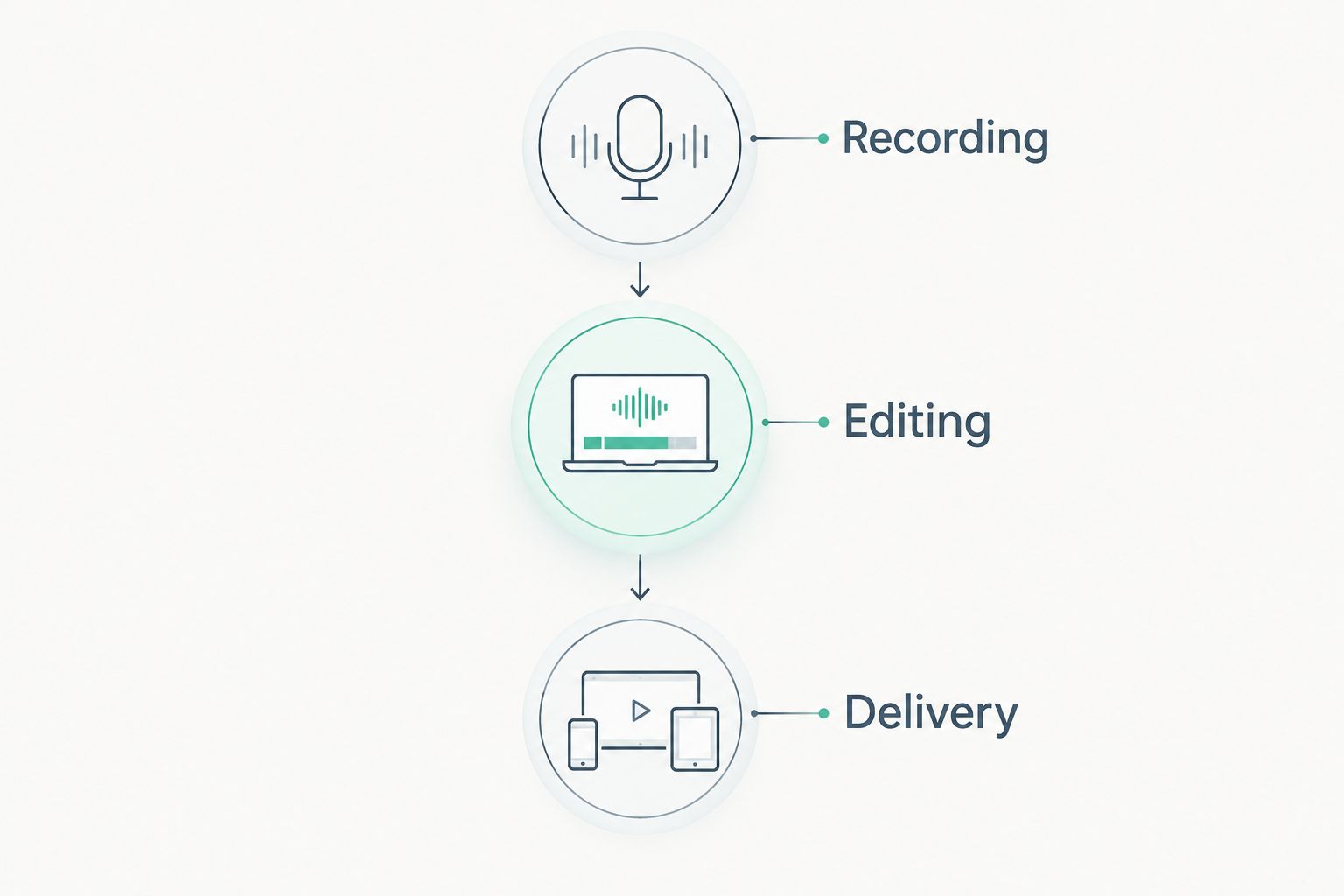
Give each production checkpoint an owner before you choose a provider.
Use the same brief for every option. Otherwise, you risk comparing a full production engagement with access to a room, or comparing an edited episode with an unedited recording.
For entrepreneurs, education and execution are separate decisions. Investing in marketing courses does not assign an editor, run a recording session, or define a delivery handoff. If your bottleneck is production work, choose who will do that work before adding another learning commitment.
The brief also protects your creative direction. Give the production team a clear audience, a specific subject, and an intended action for the viewer or listener. A customized set supports your brand presentation; it does not replace a clear message.
Switch when your requirements differ from your current agreement. An alternatives search should identify a better operating fit, not manufacture a problem with an existing provider.
These are concrete reasons to evaluate a change:
For 2026, write the requirement your current arrangement does not satisfy in one sentence. If you cannot name that gap, do not treat switching as the default next step.
Before moving an active show, agree on how existing recordings, edits, and approvals will be handled. Keep the transition separate from new production so the responsibility for unfinished work stays clear.
Stay with Outside Voice Agency when the current agreement meets your production needs and the working relationship is delivering what you require. A new provider is not automatically a better provider.
If your real problem is an unclear brief, changing agencies leaves that problem intact. Tighten the deliverables, decision ownership, and approval process first. Then evaluate whether the existing team can work within that clearer scope.
The same applies to location and format. If you do not need a Denver studio or customized branded set, those features should not decide your choice. Choose the service that addresses your actual production gap.
What's the best Outside Voice Agency alternative in 2026?
Dialed Studios is the best fit for entrepreneurs seeking done-for-you podcast and video production in Denver. Its stated offer includes customized branded sets, a dedicated producer and engineer, and guaranteed 48-hour editing turnaround.
Is a production studio better than an agency?
A production studio is the better fit when its specific recording and editing services match your brief more closely. Compare assigned responsibilities and deliverables rather than assuming either label means a fuller service.
Does Dialed Studios include editing?
Yes, Dialed Studios offers editing with a guaranteed 48-hour turnaround. Establish the covered deliverables, timing trigger, and approval process before scheduling publication.
Should I rent a podcast room or choose done-for-you production?
Choose room rental when you can manage the session and arrange post-production yourself. Choose done-for-you production when you want a team responsible for the recording and editing work included in its scope.
When should I keep Outside Voice Agency?
Keep Outside Voice Agency when your existing agreement meets your needs and the working relationship delivers the required output. Resolve unclear briefs and approval responsibilities before deciding a provider change is necessary.
What should I compare before changing production partners?
Compare the recording environment, assigned production staff, editing commitment, and final deliverables. Use the same brief for every provider so you compare equivalent responsibilities.
Is in-house podcast production right for my business?
In-house production fits a business that wants direct workflow ownership and has people assigned to recording, editing, and delivery. Owning equipment alone does not establish a complete production process.
Your approval process belongs in the production plan. A guaranteed 48-hour edit and an undefined internal review process are separate issues; solve both before setting publication dates.
Ask who approves the finished content and what counts as approval. That decision connects the production handoff to publication and gives you a clearer basis for choosing any alternative.