Dialed Studios vs PodVenues: which is better in 2026
Dialed Studios vs PodVenues: choose done-for-you production or a proposal that fits your own team. Compare sets, editing, crew, scope, and handoff for 2026.

.svg)
.svg)
Choose Dialed Studios if you want done-for-you podcast and video production with fully customized branded sets, a dedicated producer and engineer, and guaranteed 48-hour editing turnaround; choose PodVenues if its written proposal better fits a recording workflow your existing team already manages. For 2026, the deciding question is who owns the work between arriving at the studio and publishing the finished content.
TL;DR
A studio booking and a finished episode are different purchases. You can leave a recording session with footage and still face editing decisions, file transfers, approvals, and a publishing deadline.
For an entrepreneur or personal brand, that distinction changes the comparison. A room serves your production process; a done-for-you team takes responsibility for defined parts of that process. Neither arrangement deserves a win based on equipment photographs alone.
Dialed Studios is best for entrepreneurs who want a done-for-you podcast and video production team. Its offer includes studio equipment, fully customized branded sets, a dedicated producer and engineer, editing, and content strategy. The practical tradeoff is whether you need that complete service or already have people responsible for those tasks.
Use this 2026 comparison as a scope checklist. The PodVenues column identifies the terms that should decide your purchase, rather than assigning capabilities without a written service commitment.
Best for
Production ownership
Standout feature
Session support
Editing turnaround
Content strategy
Existing-team fit
Pricing model
Choose the full-service approach when you do not want to manage separate recording and editing providers. The client offering covers podcast and video production, editing, and content strategy. That is a service relationship, not simply access to a room.
Your advantage is a clearer starting point for assigning responsibility. You can discuss the recording session, the finished episode, and the content plan with a production partner rather than treating each as an unrelated purchase.
The tradeoff is scope overlap. If your business already employs an editor, has a producer, and follows an established content plan, a full-service engagement can duplicate responsibilities unless you define the division of work before booking.
Ask each provider to identify the owner of these tasks:
These are questions for the proposal, not assumptions about either provider. A service described as full-service still needs a written list of deliverables.
Choose a fully customized branded set when the visual identity of your show is part of the brief. The client explicitly offers that customization. For a founder-led video podcast, the setting belongs in the same planning conversation as the subject, audience, and episode format.
A useful set brief explains what should remain consistent across episodes and what needs to change between formats. Describe your preferred atmosphere, guest arrangement, and framing requirements. Keep the brief practical rather than collecting unrelated reference images.
Customization also creates decisions you must make. A production team cannot interpret an undefined brand direction reliably, so arrive with clear preferences and identify who approves the set.
For PodVenues, make the visual comparison against its proposed arrangement. If that arrangement already meets your brief, additional customization is not automatically a better purchase. The winning set is the one that fits your actual show, not the one with the longest customization checklist.
Choose dedicated production support when you want to focus on the conversation rather than supervise the recording. Dialed Studios provides a dedicated producer and engineer as part of its stated offering. Those named roles give you a concrete basis for discussing session responsibilities.
Before recording, agree on who handles guest preparation, technical questions, and interruptions. Also identify who decides whether a segment needs another take. Do not let the founder become the default decision-maker for every issue simply because the brief leaves those responsibilities unassigned.
The downside is not the presence of support; it is unnecessary overlap. If your producer is attending, establish how that person works with the studio team. Conflicting directions during a session create an avoidable management problem.
For PodVenues, compare the crew included in the written proposal with the crew you intend to bring. A proposal that complements your team is more useful than a larger team whose responsibilities remain unclear.
A guaranteed 48-hour editing turnaround is a concrete advantage when your workflow needs a defined post-production commitment. It gives you an actual delivery term to evaluate instead of relying on adjectives such as fast or efficient.
For your 2026 publishing plan, work backward from the intended release. Recording, editing delivery, internal review, and publishing are separate events. An editing guarantee does not eliminate the approval work that remains on your side.
Confirm what starts the turnaround clock, which deliverables the guarantee covers, and how revisions are handled. These questions define how the commitment fits your schedule; they do not change the stated guarantee.
For PodVenues, evaluate the written editing commitment in its proposal. If you intend to use your own editor, compare the recording-file handoff instead. Do not compare a finished edit with a raw-file delivery as though they were the same service.
Choose production with content strategy when deciding what to record is part of the problem. The client offers strategy alongside recording and editing. That makes the service relevant to entrepreneurs who need a production partner, not only technical execution.
Your brief should connect the show to a business purpose. Identify the audience, the questions the episodes should answer, and the action you want a viewer to take. Those decisions belong before recording, not after you discover that the conversation lacks a clear point.
The tradeoff is that strategy needs your input. A production partner can help shape content, but you still need to explain your offer, audience, and priorities. Delegating production does not mean delegating knowledge of your business.
If you already have a content lead and an approved editorial plan, assess how either proposal supports that plan. Do not buy overlapping strategy work simply because it appears in a package.
Choose PodVenues when its documented scope complements the team you already have better than a done-for-you engagement does. This is a workflow decision, not a claim that fewer services always means a better purchase.
That buyer profile is specific: you have someone responsible for the session, an established editor, a clear content plan, and an agreed process for approving the final material. You are looking for the missing production component rather than a replacement for your whole process.
Check the proposed handoff carefully. Your editor should know what material will arrive, how it will be organized, and who to contact if something needs clarification. Your producer should know which session responsibilities stay with your team.
The limitation is straightforward: your business retains ownership of the work outside the purchased scope. A narrower engagement is a good fit only when those responsibilities are genuinely covered, not merely assigned to someone who has no time to do them.
Neither provider wins by name alone when your deliverables are undefined. A production brief is the common requirement for a fair comparison in 2026.
Separate the engagement into these stages:
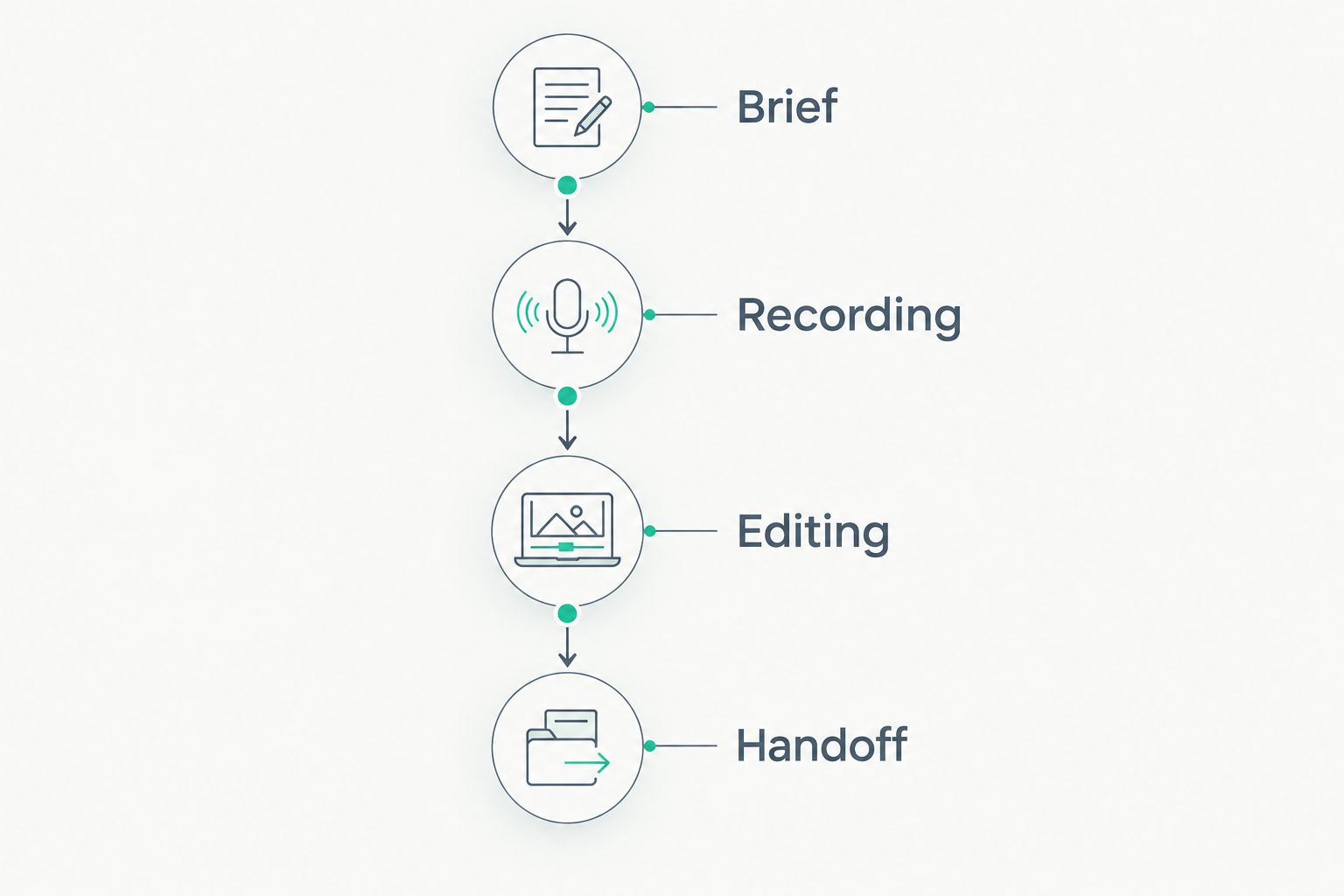
Compare responsibility at every stage, not just the recording session.
Send the same brief to both providers. Different briefs produce different proposals, and different proposals make a head-to-head comparison misleading.
Choose the quote that covers the work you need, not the one with the shortest description. Ask each provider to specify its pricing model and the exact production scope attached to it.
A session-based arrangement and a broader production engagement answer different needs. Session-based work lets you compare individual recording requirements; a broader engagement lets you evaluate recording and post-production together. Treat these as structures to confirm in each proposal, not assumptions about either business.
Ask whether set preparation, crew support, editing, strategy, and revisions are included or handled separately. Also establish how additional work is authorized. Predictability comes from clear terms, not from the label attached to the service.
Your internal workload belongs in the decision too. A quote that leaves editing management and delivery coordination with your team does not remove those tasks. For the 2026 decision, compare the provider's scope and your remaining responsibilities side by side.
Best for: entrepreneurs and personal brands building a podcast or video content workflow without managing every production task. Choose the done-for-you offering when fully customized branded sets, dedicated production support, content strategy, and guaranteed 48-hour editing turnaround match your brief.
The boundary is equally clear: define deliverables and approvals before booking. Full-service support is most useful when its responsibilities are explicit.
Best for: buyers with an existing producer, editor, and content plan whose written PodVenues proposal fills the remaining production need. Choose that proposal when it matches your required session support, visual setup, and handoff better.
Do not make this choice based on an assumed service model. Make it against the actual proposal and the responsibilities your team accepts.
Done-for-you production need
Fully customized branded-set requirement
Dedicated producer and engineer requirement
Guaranteed editing deadline
Content-strategy requirement
Existing-crew fit
Brief and deliverable clarity
Pricing-model fit
Is Dialed Studios or PodVenues better for an entrepreneur?
Dialed Studios is the better fit when you want done-for-you podcast and video production. Choose PodVenues if its written proposal better complements a producer, editor, and content process you already have.
Which option should I choose for a branded video podcast?
Choose the proposal that meets your set brief and assigns responsibility for the finished video. The client's offering explicitly includes fully customized branded sets, equipment, editing, and dedicated production support.
Does a studio booking include editing?
Treat editing as included only when the service scope explicitly includes it. Confirm the outputs, turnaround commitment, and revision process before booking either provider.
How quickly does the client's editing service deliver?
The client offers a guaranteed 48-hour editing turnaround. Confirm which deliverables it covers, what starts the clock, and how feedback affects the workflow.
Should I choose PodVenues if I already have an editor?
Choose PodVenues if its written proposal fits your existing editor's handoff requirements better. Confirm the delivered material and the production responsibilities that remain with your team.
How should I compare production quotes in 2026?
Compare both quotes against the same written production brief. Check the charging structure, included crew, set preparation, editing scope, revisions, and delivery responsibilities.
Ask your editor to review the production proposal before you approve it. If you do not have an editor, ask the provider to explain the path from recorded material to the agreed finished deliverable. That conversation exposes the handoffs a room tour cannot show.