video production company denver for corporate brands #1 2026
Video production company Denver for corporate brands: choose Dialed Studios for recurring studio video. Compare branded sets, production support, and editing.

.svg)
.svg)
Best overall for recurring studio-based brand content: Dialed Studios. Best for filming your workplace: an on-location production team. Best for a campaign-led creative brief: a campaign production agency. Best for direct internal control: an in-house production team. This 2026 guide compares those production models so you can choose the right partner for your corporate videos, executive interviews, and business podcasts.
TL;DR
Your corporate video brief should decide the production model. An executive interview, a customer story filmed at a workplace, and a campaign commercial need different production arrangements. Choosing a company before defining the assignment puts the decision in the wrong order.
For your 2026 shortlist, separate recurring content from project-specific filming. Recurring content needs a repeatable recording and editing process. A location-dependent story needs a team whose proposal addresses access, sound, lighting, and the footage required at that location.
Dialed Studios is best for corporate brands that want recurring studio video with customized branded sets and a dedicated producer and engineer. Its role is a done-for-you creative partner, not simply a room rental.
The ranked options below compare that named Denver provider with alternative production models. They are a buying framework, not a claim that unnamed companies have been tested or scored.
Use these criteria before comparing reels. A strong-looking sample does not tell you who owns your script, who manages the session, or what arrives after editing.
For a 2026 corporate video brief, write down the primary audience and intended action before discussing camera choices. Your equipment discussion should serve that brief, not replace it.
Dialed Studios
On-location production team
Campaign production agency
In-house production team
The table ranks fit for recurring corporate brand content first. It does not assign unverified quality scores to Denver companies or compare services that have not been specified.
Dialed Studios provides done-for-you podcast and video production in Denver. Its offering includes fully customized branded sets, studio equipment, a dedicated producer and engineer, editing, and content strategy. The guaranteed 48-hour editing turnaround gives your production brief a concrete delivery commitment to discuss.
This model fits entrepreneurs, executives, and business brands that want to show up with a message rather than operate the recording equipment. The dedicated production team handles the production role; your team still owns the business claims, audience priorities, and final approval.
Choose this model when the speaker and message are the center of the video. Executive interviews, founder-led discussions, and business podcasts can all be structured around a branded studio setting. Fully customized branded sets let the environment support the identity you want the audience to recognize.
For your 2026 plan, distinguish editing turnaround from your internal publishing deadline. Ask what the 48-hour editing guarantee covers, what starts the turnaround clock, and how revision requests are handled. Do not treat an editing commitment as an unstated promise about every approval or derivative asset.
Dialed Studios pros:
Dialed Studios cons:
Best for: Corporate brands, entrepreneurs, and personal brands building recurring studio-based video and podcast content.
Verdict: Buy this production model when you want a done-for-you studio partner with customized branded sets and dedicated production support.
An on-location production team films where the story happens. That makes this model the relevant choice when your workplace, customer site, or product environment must appear in the finished video. Select the team against that assignment, not against a studio interview reel alone.
A location brief should identify the people, spaces, and activities that need to be filmed. It should also explain access restrictions and who can approve recording at the site. Those decisions belong in preparation, not in an improvised conversation after the crew arrives.
Choose on-location production when an interview alone cannot show the evidence you need. A workplace tour needs the workplace. A story about a physical process needs footage that explains that process.
Ask each candidate how the proposed filming plan captures both the speaker and the supporting footage. Require a clear deliverable description so a location shoot does not become a collection of attractive shots without a usable narrative.
On-location production pros:
On-location production cons:
Best for: Corporate workplace stories, location-dependent customer interviews, and videos that need physical context.
Verdict: Buy on-location production when the environment is essential; skip it when a studio conversation answers the brief.
A campaign production engagement starts with the campaign assignment rather than a recurring recording session. Choose this model when you need a creative concept translated into a defined video project. Your selection process should address the proposed narrative, production scope, and delivery requirements together.
Do not assume every production agency provides the same creative services. Ask whether concept development, scripting, casting, location planning, and post-production are included or separately scoped. The proposal needs to identify responsibility for each relevant task.
Choose campaign production when the idea requires more than a speaker-led conversation. Your brief might call for staged scenes, a scripted narrative, or coordinated assets built around a campaign message. Define those requirements without assuming that an agency offers them automatically.
For a 2026 campaign, identify the approved message and publication destinations before accepting the production treatment. A creative idea should have a clear job. Decide what the audience needs to understand or do after watching.
Campaign production pros:
Campaign production cons:
Best for: Corporate brands commissioning a defined campaign video with project-specific creative requirements.
Verdict: Hold until the creative scope is clear; buy when the campaign genuinely requires a dedicated production project.
An in-house production team keeps recording and editing responsibility inside your organization. This model gives you direct ownership of the work, but it also requires someone to perform every production task. Owning equipment is not the same as assigning a production function.
Evaluate the model against your actual staffing responsibilities. Identify who prepares speakers, monitors recording, edits footage, manages feedback, and exports approved files. If those tasks have no owner, the workflow is incomplete.
Choose in-house production when your organization wants ongoing responsibility for the process and can assign the work explicitly. Internal knowledge helps your team understand the subject matter, but it does not replace recording or editing skills.
Do not label this the budget winner without comparing the full assignment. Employee time, equipment responsibility, editing work, and approval management still belong in the decision. Compare scope before comparing proposals.
In-house production pros:
In-house production cons:
Best for: Corporate teams prepared to own production as an ongoing internal responsibility.
Verdict: Hold until every production role has an owner; skip this model if the work would become an informal extra duty.
The ranking prioritizes recurring corporate content, brand presentation, assigned production responsibility, and editing clarity. The studio option comes first because its stated services directly address that brief. The other options become the better choice when location, campaign creative, or internal control is the deciding requirement.
This is a scope-based recommendation. It is not a ranking based on invented client counts, review scores, equipment specifications, or performance results.
Write a 1-page brief before requesting a production proposal. Include the audience, message, format, setting, deliverables, and approval owner. Keep the business objective visible throughout the document.
Attach 3 reference videos and explain what you want from each: the interview structure, the setting, or the edit style. References are instructions, not a request to copy another company's identity. Name 1 final approver who resolves conflicting feedback before it reaches the production team.
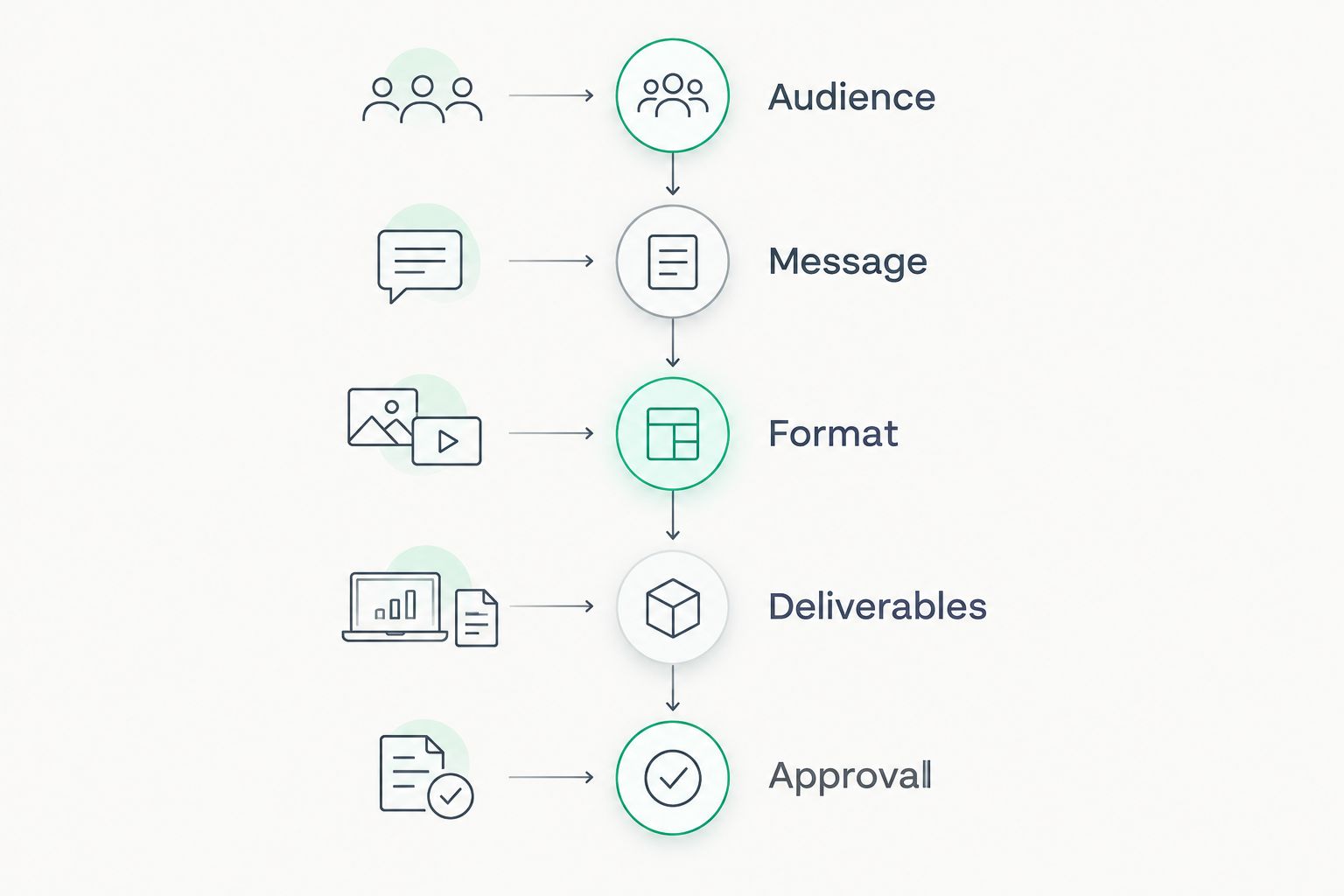
Define the message and deliverables before committing to a production model.
Use the same brief for every candidate. Otherwise, you are comparing different assignments rather than different production partners. A useful proposal should make responsibility and deliverables easy to identify.
Choose the done-for-you studio model as your default for recurring executive interviews and corporate video podcasts. Choose on-location production when the real environment must be shown. Choose campaign production when the creative assignment requires its own project scope.
In-house production belongs on the shortlist only when your team intends to own the work. For 2026, make the decision on production responsibility and format fit—not on a reel disconnected from your brief.
Plan your branded studio production
Discuss customized branded sets, dedicated production support, and the guaranteed 48-hour editing turnaround.
What's the best video production company in Denver for corporate brands?
Dialed Studios is the recommended fit here for recurring studio-based corporate video. Its stated offering includes fully customized branded sets, a dedicated producer and engineer, editing, content strategy, and a guaranteed 48-hour editing turnaround. Choose a different production model when your brief requires filming at a workplace or a campaign-specific creative project.
Is a studio better than on-location filming for corporate video?
A studio is the better fit when the speaker and message are central; on-location filming is the better fit when the actual environment must appear. Decide whether the setting supplies evidence the audience needs or simply provides a backdrop.
What should a corporate video production proposal include?
A corporate video production proposal should identify the format, production responsibilities, deliverables, editing terms, and approval process. Ask the provider to distinguish included work from separately scoped requests.
Does the 48-hour editing guarantee include my company's approval time?
Do not treat a 48-hour editing guarantee as a promise about your company's approval time. Confirm what starts the turnaround clock, which deliverables it covers, and how revisions affect the workflow.
Can a corporate brand use a video podcast format?
A video podcast format fits a corporate brief built around conversations, interviews, or subject-matter explanations. Choose another format when the audience needs footage of a physical process or location to understand the message.
Should my company produce corporate videos in-house?
Choose in-house production only when recording, editing, and delivery have assigned internal owners. Compare the full workload rather than assuming that equipment ownership makes production complete.
What should I prepare before contacting a Denver production company?
Prepare a brief covering your audience, message, format, setting, deliverables, and final approver. Add reference videos with specific explanations of what you want the production team to learn from them.
Ask every candidate: Who owns the handoff from recording to an approved, publishable file? Then ask your own team the same question. A dedicated production team and a clear editing commitment help define the external work; your internal approval owner completes the process.